MCF-stack: Special Solutions of Mean Curvature Flow

§ 5.14 Rotational degenerate neckpinch solutions1E4AD3904D39

Earliest recorded reference: (publication year).

Paper credits and chronology

Paper credits are chronological and include every author of the cited papers. They identify sources, not exclusive discovery credit. Background-only citations do not determine the date of this example. A classical example may predate the references recorded here.

  1. Angenent–Velázquez — 1997 (publication year).
1E4AD3904D39
922034E946EB

(Angenent–Velázquez type-II singularities) Let $n\geq 2$, let $m\geq 3$ be odd, and let $K>0$. Choose a compact rotational target hypersurface in $\mathbb R^{n+1}$, smooth away from a cusp at the origin, whose radius satisfies $u_*(x)\sim \sqrt K\, x^{m/2}$ as $x\downarrow 0$ and whose other tip closes smoothly. Angenent and Velázquez construct smooth compact rotational mean curvature flows

\[ M_ t=\{ (x,u(x,t)\omega ):a(t)\leq x\leq b(t),\ \omega \in S^{n-1}\} , \qquad t_0<t<T, \]

with smooth caps and positive radius between them. Each regular slice is an embedded sphere, hence complete and proper. The constructed flows remain close to the chosen target outside a small neighborhood of the origin as the construction interval is shortened. They are not supplied as ancient solutions or as solitons, and no closed formula for $u(x,t)$ is given.

Set $\xi _*=(2(n-1)/K)^{1/m}$. At the left tip,

\[ a(t)=-(\xi _*+o(1))(T-t)^{1/m},\qquad |\vec H|_{\rm tip}(t)=\left(\frac{\xi _*}{m}+o(1)\right)(T-t)^{1/m-1}. \]

Here the curvature coefficient is for the trace mean curvature, equivalently the magnitude $|\vec H|$ at this convex tip. Rotational smoothness makes the $n$ principal curvatures equal at the tip, so $|A|_{\rm tip}=|\vec H|_{\rm tip}/\sqrt n$. The maximum of $|A|$ is attained there; its blow-up rate is type II. The parabolic rescalings at the origin converge smoothly on compact sets to $S^{n-1}_{\sqrt{2(n-1)}}\times \mathbb R$, whereas rescaling about the tip by $A_{\max }(t)=\max _{M_ t}|A|$ yields the rotational translating bowl with tip $|A|=1$. This last normalization has translation speed $\sqrt n$; rescaling instead by $|\vec H|_{\rm tip}$ gives the speed-one bowl.

Under the intermediate scaling $x\mapsto x/(T-t)^{1/m}$ and $r\mapsto r/(T-t)^{1/2}$, the limiting profile is

\[ r=\sqrt{2(n-1)+Kx^ m},\qquad x\geq -\xi _*. \]

This last expression is an asymptotic limiting profile, not an exact formula for the evolving compact hypersurface. Source: [AV97], Introduction, items 1–5, printed pp. 16–17, supplied PDF pp. 2–3; the construction is justified in Sections 3–7. The even-$m$ modifications and the formal $m=2$ discussion are not included in this entry. The illustration selects $n=2$, $m=3$, $K=1$, and writes $s=T-t$. Its time sequence uses one spatial scale to show the left tip approaching the origin while the outer cap persists; the final cusp target is not a smooth time slice. For the profile near the origin, item 5 of the Introduction gives

\[ \frac{u(y\sqrt{s},T-s)}{\sqrt{s}} =\sqrt{2}+\frac{\sqrt{s}}{2\sqrt{2}}(y^3-6y)+o(\sqrt{s}) \]

on bounded $y$ intervals. This leading Hermite correction explains the small bulge and neck in the cylindrical region. The rotatable compact slices blend the asymptotic profiles with a numerically integrated bowl cap and a chosen outer cap: they are illustrative schematics, not a computed solution of the compact MCF initial-value problem, and their displayed times carry no certified finite-time accuracy. Separate views compare the meridians and the three blow-up limits; the intermediate view uses unequal axial and radial scaling. The construction does not classify all type-II singularities or impose global convexity on every allowed target.
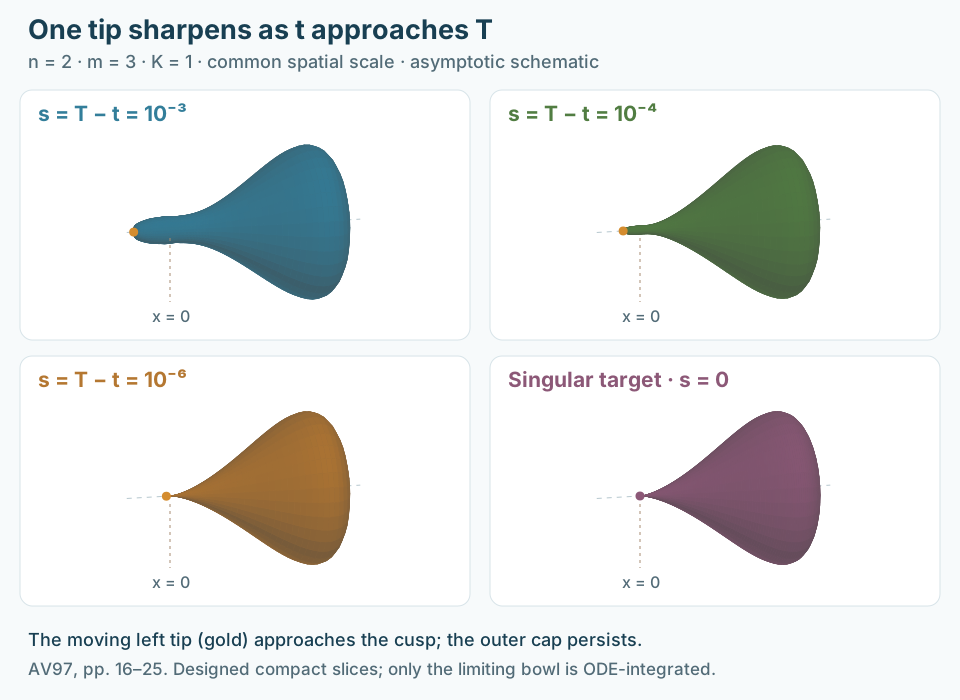
Four views at a common spatial scale show the left tip advancing toward the origin and sharpening into a one-sided cusp. The outer cap persists. The compact surfaces are asymptotic schematics with numerical bowl caps.
Asymptotic time sequence with numerical bowl cap. Three illustrative times approach the odd-cubic degenerate neckpinch; the fourth panel is a singular cusp target. All four use the same spatial scale. Rotate, play toward the singular time, compare meridians, or inspect the cylinder, intermediate profile, and bowl limits. Compact slices and joins are schematic, not a numerical MCF evolution; only the limiting bowl is integrated from its ODE. Shown in R3 with n=2, m=3, K=1. Open drawing · Numerical references and credits

Ambient space, topology, embeddedness and entropy

Topology is for regular time slices before the singular time.

Surface neckpinches · Euclidean space ℝ³ · Embedded
Ambient space
Euclidean space ℝ³
Topology
Sphere S²
Embeddedness
Embedded: Every regular slice before the singular time is an embedded sphere; the singular limiting profile is not the classified slice.
Compactness
Compact
Surface genus
0
Topological ends
0 (compact)
Entropy
Finite; value not recorded: Finite; no value recorded.
Gaussian area
Not recorded: Not recorded in this entry.
Higher-dimensional neckpinches · Euclidean space ℝ⁴; Euclidean dimension ≥ 5 · Embedded
Ambient space
Euclidean space ℝ⁴; Euclidean dimension ≥ 5
Topology
Sphere Sⁿ, n ≥ 3
Embeddedness
Embedded: Every regular slice before the singular time is an embedded sphere; the singular limiting profile is not the classified slice.
Compactness
Compact
Surface genus
Not a surface
Topological ends
0 (compact)
Entropy
Finite; value not recorded: Finite; no value recorded.
Gaussian area
Not recorded: Not recorded in this entry.

Compare examples by these properties →

References on this page

  1. [AV97] Sigurd B. Angenent and Juan J. L. Velázquez. Degenerate neckpinches in mean curvature flow. Journal für die reine und angewandte Mathematik, 482:15–66, 1997. Printed page = supplied PDF page + 14. Odd m at least 3 is the constructed family used here; asymptotic profiles are not exact time-dependent formulas. URL: https://doi.org/10.1515/crll.1997.482.15, doi:10.1515/crll.1997.482.15.All uses in this project ↩ 1
Cite this page

Comments

Comments are not enabled yet.