MCF-stack: Special Solutions of Mean Curvature Flow

§ 5.1 The ancient sine wave (Nakayama–Iizuka–Wadati, 1994; Angenent–You, 2018)D8ADD5B24C33

Earliest recorded reference: (publication year).

Paper credits and chronology

Paper credits are chronological and include every author of the cited papers. They identify sources, not exclusive discovery credit. Background-only citations do not determine the date of this example. A classical example may predate the references recorded here.

  1. Nakayama–Iizuka–Wadati — 1994 (publication year).
  2. Angenent–You — 2018-03-04 (first arXiv submission).
D8ADD5B24C33
3BF94583DFB1

An exact eternal graphical solution of planar curve shortening is

\[ X(x,t)=(x,\operatorname {arsinh}(e^{-t}\sin x)),\qquad x\in \mathbb R,\quad t\in \mathbb R. \]

Writing its height as $u$, direct differentiation gives $u_ t=u_{xx}/(1+u_ x^2)$; this also fixes the time normalization. Spatial translations, time translations and parabolic dilations give the usual equivalent versions. Nakayama–Iizuka–Wadati's ancient sine wave is recalled in Angenent–You's introduction. Each slice is complete, proper and embedded, with parameter topology $\mathbb R$, two ends and period $2\pi $ in $x$. It is nonconvex and has infinite total absolute curvature, because each spatial period has a positive curvature integral. At each fixed finite time its slope is bounded, so it has finite Gaussian area and entropy, without a uniform-in-time value asserted here. Forward in time it approaches the axis; backward, long nearly vertical portions are joined near successive extrema. The exact graph are shown at three times. This is distinct from the finite-total-curvature grim chains.

Sources: [NakayamaIizukaWadati1994, AY18].
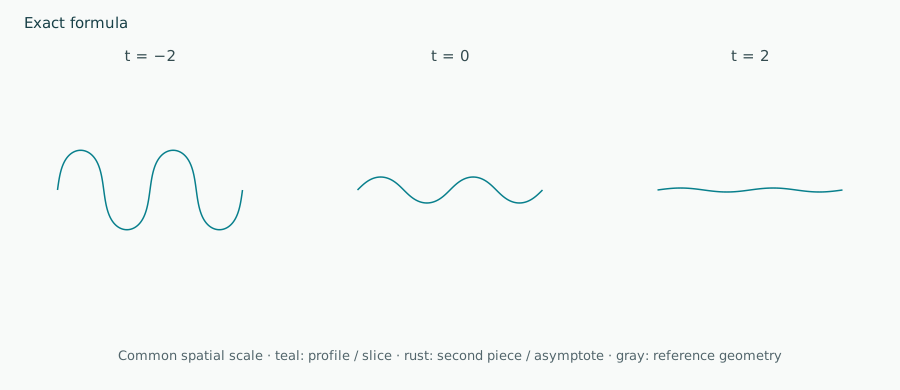
The ancient sine wave. Exact graph y = asinh(exp(−t) sin x), shown at three real times without rescaling the axes. The forward flattening and backward growth are actual curve shortening.
Exact formula. Exact graph y = asinh(exp(−t) sin x), shown at three real times without rescaling the axes. The forward flattening and backward growth are actual curve shortening. Open drawing · Numerical references and credits

Ambient space, topology, embeddedness and entropy

Source construction and dimension restrictions are stated on the reading page. Illustrations have their own accuracy labels.

Complete periodic graph in ℝ² · Euclidean plane ℝ² · Embedded
Ambient space
Euclidean plane ℝ²
Topology
ℝ with spatially periodic height
Embeddedness
Embedded: The cited construction gives an embedding for this case.
Compactness
Noncompact
Surface genus
Not a smooth surface; surface genus is inapplicable.
Topological ends
Two topological ends.
Entropy
Finite; value not recorded: Finite on each stated smooth slice; no numerical value or uniform time bound is recorded.
Gaussian area
Finite; value not recorded: Finite on each stated smooth slice; no numerical value or uniform time bound is recorded.

Compare examples by these properties →

References on this page

  1. [NakayamaIizukaWadati1994] Kazuaki Nakayama, Takeshi Iizuka, and Miki Wadati. Curve Lengthening Equation and Its Solutions. Journal of the Physical Society of Japan, 63:1311–1321, 1994. URL: https://doi.org/10.1143/JPSJ.63.1311, doi:10.1143/JPSJ.63.1311.All uses in this project ↩ 1
  2. [AY18] Sigurd Angenent and Qian You. Ancient solutions to curve shortening with finite total curvature. 2018. arXiv:1803.01399v1. Selected theorem statements and construction passages checked November 6, 2026; proofs are cited, not independently verified. URL: https://arxiv.org/abs/1803.01399v1.All uses in this project ↩ 1
Cite this page

Comments

Comments are not enabled yet.