955BE4106D88
Let $n\geq 3$, $A\ne 0$ be skew-symmetric, and $v\ne 0$ satisfy $Av=0$. The arclength system
has a unique complete solution on $\mathbb R$ for each point and unit tangent. Here $P_ Tw=w-\langle w,T\rangle T$. It generates the eternal curve-shortening flow
This is an exact time evolution of an ODE-defined curve in codimension $n-1$. To select genuinely rotating examples, require $P_ T(AC)$ not to vanish identically; the axis line and purely translating curves in $\ker A$ are excluded. A rigidly rotating and translating soliton is different from the shrinking helix in 5.16, whose radius changes with time.
The scalar height $h(s)=\langle v,C(s)\rangle $ satisfies
It is either strictly monotone with range $\mathbb R$, or has exactly one global minimum and tends to $+\infty $ at both ends. In the monotone case projection to the translation axis gives an embedding. In the minimum case each branch is a graph over its height range, but this alone does not establish that the two branches are disjoint. All these curves are proper complete immersions with domain $\mathbb R$ and two ends; the height diverges in absolute value at each end. The norm of the projection to $\operatorname {range}A$ tends to either zero or infinity along each end. We do not replace this projection by distance to the translation line when $\dim \ker A>1$.
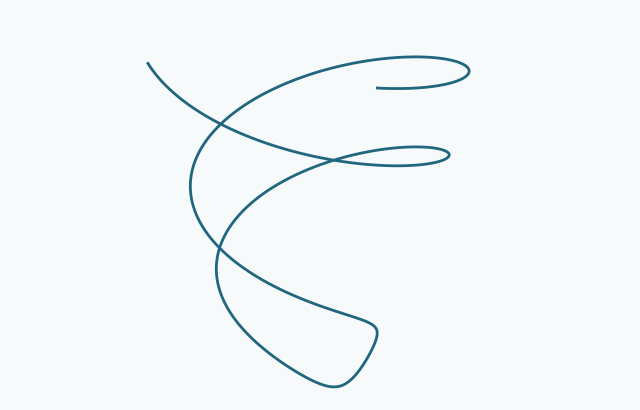
In $\mathbb R^3$, write $A(x,y,z)=\omega (-y,x,0)$ and $v=be_3$ with $\omega ,b>0$. A family with two upward ends is obtained by choosing $C(0)=(r,0,0)$, $T(0)=(0,1,0)$, $r>0$: $z_ s(0)=0$ and $z_{ss}(0)=b$. This is a concrete initial-value construction, not a closed spatial formula. The illustration uses $r=\omega =b=1$ and shows a finite arclength window. Its time control applies the exact screw motion to the numerical profile. The general higher-dimensional construction allows any nonzero skew map with a nontrivial kernel and any $v\in \ker A\setminus \{ 0\} $.
Source: [AAAW13], Section 4.1 and Lemmas 5.2 and 6.4, PDF pp. 11–12, 14–15, and 20–22. The two height alternatives are read with the proof of Lemma 6.4; its displayed $\pm \infty $ notation does not require opposite signs at the two ends. No global uniqueness with prescribed ends, stability classification, or quantitative Gaussian-area or entropy result is recorded.
Comments
Comments are not enabled yet.