9FAA74B5E7DA
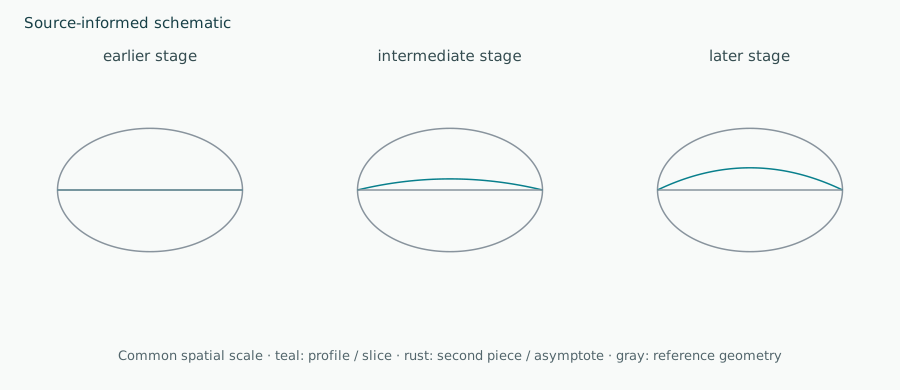
Let $\Omega \subset \mathbb R^2$ be a smooth bounded strictly convex domain, and let $D$ be an orthogonal diameter: a straight segment in $\overline\Omega $ meeting $\partial \Omega $ orthogonally at both endpoints. Bourni–Burns–Catron construct convex ancient free-boundary curve-shortening solutions approaching $D$ backward, one on each side, with the uniqueness qualifications in Theorem 1.1. The unit-disk family is a special case, cross-linked separately. Each regular slice is an embedded compact arc with endpoints moving on the fixed boundary and perpendicular contact there. Its topology is an interval, and it has no noncompact ends. The domain is not scaled with the curve. The construction is by parabolic limits, not an explicit family of elliptical arcs. The visualization uses a strictly convex elliptical domain to distinguish the fixed barrier from the evolving arc, and displays the orthogonal diameter as a backward limit. The intermediate curves are schematic; exact contact and numerical PDE convergence are not inferred from an ellipse drawing.
Sources: [BourniBurnsCatron2025].
Comments
Comments are not enabled yet.