MCF-stack: Special Solutions of Mean Curvature Flow

§ 5.10 Compact nonconvex ancient spiral curvesF98988E964AC

Earliest recorded reference: (first arXiv submission).

Paper credits and chronology

Paper credits are chronological and include every author of the cited papers. They identify sources, not exclusive discovery credit. Background-only citations do not determine the date of this example. A classical example may predate the references recorded here.

  1. Zhang–Olson–Khan–Angenent — 2022-04-11 (first arXiv submission).
F98988E964AC
505A2B69BD4F

Zhang–Olson–Khan–Angenent construct compact embedded ancient curve-shortening flows $C_ t\subset \mathbb R^2$, $t<0$, whose distant past follows a truncated rotating Yin–Yang spiral closed by a small grim-reaper-shaped cap. They are smooth simple closed curves, hence complete and proper, with no ends. They are nonconvex in the ancient regime and are neither shrinking circles nor ancient paperclips. No assertion of nonconvexity through a later maximal continuation is needed here.

The limiting rotating model has angular speed one. Its radial expansion $\mathcal R(\theta )=\sqrt{2\theta }+O(\theta ^{-3/2})$ is asymptotic, not a formula for the constructed ancient curve. If $\Omega (t)$ is the paper's truncated spiral region and $\Lambda (t)$ is the enclosed ancient region, the Main Theorem proves

\[ |\Lambda (t)\mathbin {\triangle }\Omega (t)|\leq C_\delta |t|^{-1+\delta }\qquad (t\to -\infty ) \]

for each $\delta >0$. This is an area estimate, not an exact pointwise parametrization. Gaussian area and entropy are finite at each compact slice; no uniform ancient bound is assigned.

Source: [ZOKA23], Main Theorem and equations (1.1)–(1.3), pp. 1–3, and Appendix A. No uniqueness is claimed. The source also credits Charyyev's independent construction. The figure samples the asymptotic construction at $t=-24,-18,-12,-8$ on a common spatial scale. Its blue arms solve the rotating-soliton ODE numerically; the orange cap uses the corrected grim-reaper ansatz in Section 2. These are model snapshots, not a numerical solution of the ancient evolution equation or an illustration of extinction.

To read the motion, write $E(\theta )=(\cos \theta ,\sin \theta )$ and $J(x,y)=(-y,x)$. The two arms are

\[ Y_\pm (\theta ,t)=\mathcal R(\theta -t\pm \pi /2)E(\theta ), \qquad \theta -t\pm \pi /2>\pi /2, \]

truncated near $\theta =-t$. Here $\mathcal R$ is the Appendix A solution of

\[ \tfrac 12\mathcal R^2-\theta +\arctan (\mathcal R'/\mathcal R)=0, \qquad \theta >\pi /2, \]

with $\mathcal R\downarrow 0$ as $\theta \downarrow \pi /2$. At a fixed point of the unrotated model the arms rotate counterclockwise with speed one. The cap center instead follows $R(t)E(-t)$, where $R(t)=\mathcal R(-2t)\sim 2\sqrt{-t}$, so it moves clockwise and inward. Its leading width is $\pi /R(t)$. The inset uses $X=e^{-tJ}[(R(t),0)+R(t)^{-1}(u,v)]$; its dashed reference is the leading grim reaper

\[ G(p)=(-\arcsin (\tanh p),-\log \cosh p),\qquad p\in \mathbb R. \]

The orange curve includes the paper's normal correction $(-4t)^{-1}F(p)JG'(p)$, equations (2.19)–(2.21), and a smooth interpolation to the arms. These asymptotic formulas apply in the distant past; the figure's finite time interval carries no certified approximation-error bound.
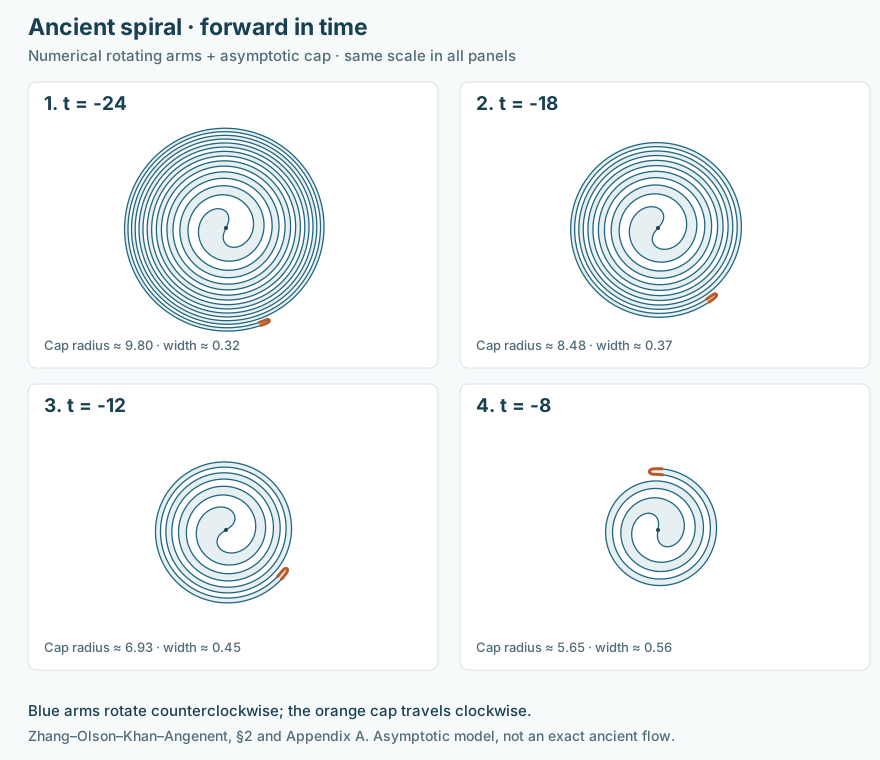
Four closed Yin–Yang spiral models at t = −24, −18, −12 and −8, shrinking and losing turns, with the outer closing cap marked orange.
Numerical ODE with asymptotic cap. Four ancient-regime times on one spatial scale, with animation and a cap close-up. The Yin–Yang arms are computed from the rotating-soliton ODE; the closing cap uses the corrected grim-reaper ansatz of Section 2. Blue arms rotate counterclockwise, while the orange cap moves clockwise and inward. This illustrates the asymptotic construction, not numerically evolved slices of the ancient PDE solution. The displayed interval does not extend to extinction. Open drawing · Numerical references and credits

Ambient space, topology, embeddedness and entropy

The time-dependent figure shows numerical rotating-soliton arms with an asymptotic cap. Its displayed times and geometry are model values, not a numerical construction or certification of the ancient solution.

Embedded ancient planar curve · Euclidean plane ℝ² · Embedded
Ambient space
Euclidean plane ℝ²
Topology
Circle S¹
Embeddedness
Embedded: Embedded regular slices in the stated ambient space; schematic projections do not determine embeddedness.
Compactness
Compact
Surface genus
Not a surface
Topological ends
0 (compact)
Entropy
Finite; value not recorded: Finite for each smooth compact slice; no uniform value over ancient time is asserted.
Gaussian area
Finite; value not recorded: Finite for each smooth compact slice; no uniform value over ancient time is asserted.

Compare examples by these properties →

References on this page

  1. [ZOKA23] Yongzhe Zhang, Connor Olson, Ilyas Khan, and Sigurd Angenent. Nonconvex ancient solutions to curve shortening flow. 2023. arXiv:2204.05253v3. Selected theorem statements and construction passages checked November 6, 2026; proofs are cited, not independently verified. URL: https://arxiv.org/abs/2204.05253v3.All uses in this project ↩ 1
Cite this page

Comments

Comments are not enabled yet.