E9086532F53A
Section 5 of [Halldorsson2013], PDF pp. 12–14, derives the classical helicoidal minimal surfaces and attributes them to Wunderlich. For $h>0$, $a\in \mathbb R$, and $(u,\phi )\in \mathbb R^2$, an exact formula is
A constant horizontal rotation may be included. The profile parameter $u$ is not arclength; in the notation of the source, $\tau =h\sinh (hu)$ and $s=(a^2+h^2)\tau /h^2$. These codimension-one minimal immersions in $\mathbb R^3$ give exact eternal stationary flows $M_ t=F(\mathbb R^2)$ for all $t\in \mathbb R$.
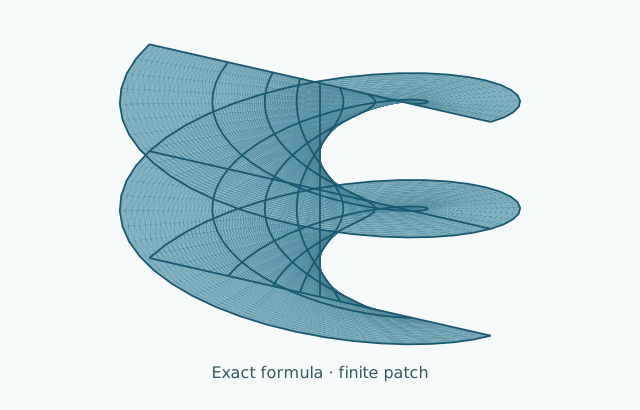
For $a=0$, changing variable $r=h\sinh (hu)$ gives the usual embedded helicoid $(r\cos \phi ,r\sin \phi ,h\phi )$, $r,\phi \in \mathbb R$. For $a\ne 0$, the profile has infinitely many self-intersections, which give self-intersections of the surface at the same height. In each case the parameter manifold is a complete proper noncompact plane, of genus zero and one end. Properness follows directly from $|X(u)|\to \infty $ and $F_3=h\phi $; completeness also follows from properness of the immersion. The screw symmetry has pitch $h$, with vertical period $2\pi h$ as a symmetry of the image. Genus and ends here describe the full parameter plane, not a quotient by that vertical period.
For $a\ne 0$, the profile has minimum radius $|a|$, reflection symmetry, constant-sign curvature tending to zero on both arms, and $rT/X\to \pm (h-ia)/\sqrt{h^2+a^2}$. These are properties of the generating curve, not convexity of the minimal surface. For fixed $a\ne 0$, its arclength parametrization tends locally smoothly to the circle $ia e^{-is/a}$ as $h\to 0$. Another scaling gives the limiting profile
This logarithmic spiral is a limiting generating curve in equation (5.4), not itself a claimed planar curve-shortening soliton; the zero-pitch surface parametrization is degenerate. No entropy, Gaussian-area or stability classification is recorded here.
Section 6 studies helicoidal surfaces of nonzero constant mean curvature for comparison. Constant mean curvature alone does not make them stationary or self-similar solutions of ordinary MCF, so that comparison family is not added as a new special flow. Its round cylindrical case is already represented by Example 2.19. The figures sample the exact formula, with parameters $h$ and $a$ and interactive rotation and zoom.
Comments
Comments are not enabled yet.