MCF-stack: Special Solutions of Mean Curvature Flow

§ 5.24 Convex eternal flows that do not translateE62279A82D37

Earliest recorded reference: (first arXiv submission).

Paper credits and chronology

Paper credits are chronological and include every author of the cited papers. They identify sources, not exclusive discovery credit. Background-only citations do not determine the date of this example. A classical example may predate the references recorded here.

  1. Bourni–Langford–Tinaglia — 2020-06-29 (first arXiv submission).
E62279A82D37
FA0C7583A161

Let $C$ be a regular circumscribed cone in the class $\mathcal P_*^ n$ of Bourni–Langford–Tinaglia, with vertex $v_ C$, and put

\[ P=C\cap \{ p:\langle p,v_ C/|v_ C|\rangle \le 1\} . \]

Their Theorem 7.1 constructs a convex eternal flow in $(-\pi /2,\pi /2)\times \mathbb R^ n$, reflection symmetric in the midplane, with squash-down $P$, which sweeps out the slab. For the nondegenerate choices in Corollary 7.2 it does not evolve by translation. The complete embedded hypersurfaces have changing geometry despite existing for every real time. The source describes translating regions emerging in the remote past and coalescing toward a translating configuration in the future. This asymptotic description is not a formula for the entire evolution or a claim that the pieces can simply be superposed. The illustration uses a truncated wedge in a spatial section and separates the backward and forward configurations. It does not identify an arbitrary deformation between them with MCF. No global topology, numeric entropy value, or general uniqueness assertion is recorded from this construction.

Sources: [BourniLangfordTinaglia2022].
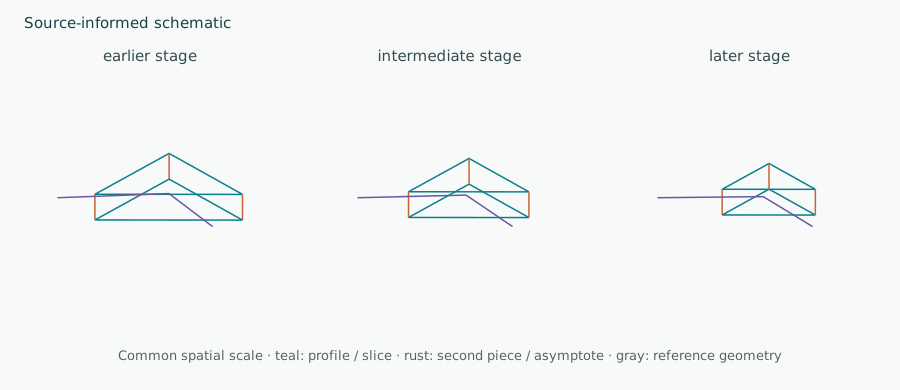
Convex eternal flows that do not translate. Qualitative coalescence of translating regions, with a truncated circumscribed wedge. The panels are asymptotic stages; the displayed deformation is not a translator or a computed MCF solution.
Source-informed schematic. Qualitative coalescence of translating regions, with a truncated circumscribed wedge. The panels are asymptotic stages; the displayed deformation is not a translator or a computed MCF solution. Open drawing · Numerical references and credits

Ambient space, topology, embeddedness and entropy

Source construction and dimension restrictions are stated on the reading page. Illustrations have their own accuracy labels.

Hypersurface case n = 2 · Euclidean space ℝ³ · Embedded
Ambient space
Euclidean space ℝ³
Topology
Noncompact convex surface; global topology not recorded here
Embeddedness
Embedded: The cited construction gives an embedding for this case.
Compactness
Noncompact
Surface genus
Not recorded.
Topological ends
Not recorded for the full parameter manifold.
Entropy
Not recorded: No quantitative conclusion is recorded from the cited construction.
Gaussian area
Not recorded: No quantitative conclusion is recorded from the cited construction.
n ≥ 3 · Euclidean space ℝ⁴; Euclidean dimension ≥ 5 · Embedded
Ambient space
Euclidean space ℝ⁴; Euclidean dimension ≥ 5
Topology
Noncompact convex hypersurface
Embeddedness
Embedded: The cited construction gives an embedding for this case.
Compactness
Noncompact
Surface genus
Not a smooth surface; surface genus is inapplicable.
Topological ends
Not recorded for the full parameter manifold.
Entropy
Not recorded: No quantitative conclusion is recorded from the cited construction.
Gaussian area
Not recorded: No quantitative conclusion is recorded from the cited construction.

Compare examples by these properties →

References on this page

  1. [BourniLangfordTinaglia2022] Theodora Bourni, Mat Langford, and Giuseppe Tinaglia. The atomic structure of ancient grain boundaries. Geometry & Topology, 26:1849–1905, 2022. URL: https://arxiv.org/abs/2006.16338, arXiv:2006.16338, doi:10.2140/gt.2022.26.1849.All uses in this project ↩ 1
Cite this page

Comments

Comments are not enabled yet.