MCF-stack: Special Solutions of Mean Curvature Flow

§ 5.45 Ancient flows from unstable free-boundary minimal hypersurfaces1897F09E9330

Earliest recorded reference: (first arXiv submission).

Paper credits and chronology

Paper credits are chronological and include every author of the cited papers. They identify sources, not exclusive discovery credit. Background-only citations do not determine the date of this example. A classical example may predate the references recorded here.

  1. Bourni–Franz — 2026-02-09 (first arXiv submission).
1897F09E9330
3846578EAD16

Let $M^{m+1}$ be a compact Riemannian manifold with strictly convex boundary, and let $\Sigma ^ m\subset M$ be a smooth properly embedded two-sided free-boundary minimal hypersurface of Morse index $I>0$. Bourni–Franz's 2026 preprint constructs an $I$-parameter family of ancient free-boundary mean curvature flows backward converging to $\Sigma $. The construction uses adapted normal graphs that preserve the nonlinear orthogonality condition; merely adding an eigenfunction to the position vector is not an exact free-boundary deformation. The uniqueness theorem additionally imposes the specified small graph and decay conditions; its generality must not be inferred solely from the index count. A mean-convex ancient branch is obtained from the first eigenfunction, with further uniqueness under nondegeneracy. Smooth graphical slices preserve the topology and embeddedness of $\Sigma $ and meet the fixed ambient boundary orthogonally. The figure shows a critical-catenoid-type free-boundary background and a schematic unstable displacement, not a computed ancient flow. The preprint's existence and classification are attributed results, with no formal proof verification recorded.

Sources: [BourniFranz2026].
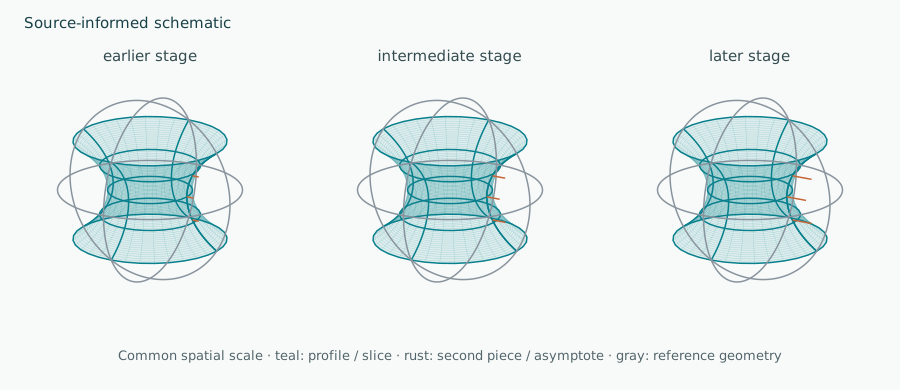
Ancient flows from unstable free-boundary minimal hypersurfaces. Fixed ambient boundary and a free-boundary minimal background with schematic unstable displacement. The three stages are not eigenfunction graphs falsely asserted to satisfy the nonlinear boundary condition.
Source-informed schematic. Fixed ambient boundary and a free-boundary minimal background with schematic unstable displacement. The three stages are not eigenfunction graphs falsely asserted to satisfy the nonlinear boundary condition. Open drawing · Numerical references and credits

Ambient space, topology, embeddedness and entropy

Source construction and dimension restrictions are stated on the reading page. Illustrations have their own accuracy labels.

Surface case m = 2 · Riemannian ambient manifold · Embedded
Ambient space
Riemannian ambient manifold
Topology
Topology of the chosen two-sided free-boundary minimal hypersurface
Embeddedness
Embedded: The cited construction gives an embedding for this case.
Compactness
Compact
Surface genus
Genus of the chosen minimal surface.
Topological ends
No ends (compact parameter manifold).
Entropy
Not applicable: Euclidean Gaussian area and entropy are not assigned to this intrinsic curved-ambient flow.
Gaussian area
Not applicable: Euclidean Gaussian area and entropy are not assigned to this intrinsic curved-ambient flow.
Hypersurface dimension m ≥ 3 · Riemannian ambient manifold · Embedded
Ambient space
Riemannian ambient manifold
Topology
Topology of the chosen two-sided free-boundary minimal hypersurface
Embeddedness
Embedded: The cited construction gives an embedding for this case.
Compactness
Compact
Surface genus
Not a smooth surface; surface genus is inapplicable.
Topological ends
No ends (compact parameter manifold).
Entropy
Not applicable: Euclidean Gaussian area and entropy are not assigned to this intrinsic curved-ambient flow.
Gaussian area
Not applicable: Euclidean Gaussian area and entropy are not assigned to this intrinsic curved-ambient flow.

Compare examples by these properties →

References on this page

  1. [BourniFranz2026] Theodora Bourni and Giada Franz. Ancient solutions to free boundary mean curvature flow. arXiv preprint, 2026. URL: https://arxiv.org/abs/2602.08850, arXiv:2602.08850.All uses in this project ↩ 1
Cite this page

Comments

Comments are not enabled yet.