D68656E88625
Let $k_1,\ldots ,k_ n\geq 0$ with $\sum _ i k_ i=1$. Hoffman–Ilmanen–Martín–White construct a complete properly embedded translating graph over an open domain $\Omega \subset \mathbb R^ n$. After reflecting their downward convention to upward translation, it satisfies
These equations specify apex data, not an explicit global formula.
The function is even in every coordinate. If $k_ i=0$ it is invariant under translation in the $i$-th coordinate; if $k_ i>0$, then $D_ i u$ has the same sign as $x_ i$ away from $x_ i=0$.
Equal apex curvatures $k_ i=k_ j$ give invariance under rotations in the $(x_ i,x_ j)$-plane.
The domain is either all of $\mathbb R^ n$ or a slab $\{ |x_ i|<b\} $. In the slab case the corresponding $k_ i$ is strictly larger than every other $k_ j$.
If the two largest prescribed curvatures are equal, the resulting graph is entire. The supplied edition obtains an $(n-2)$-parameter family of pairwise noncongruent entire examples this way.
The construction gives existence and the listed symmetries, but does not assert general uniqueness or convexity of every higher-dimensional graph. In particular, apex positivity alone is not a global convexity theorem.
See [HIMWGraphical18], Theorem 8.1 and Corollary 8.2, PDF page 18. The source also has a prescribed-width slab construction in Section 11; its final discussion explicitly leaves general convexity open.
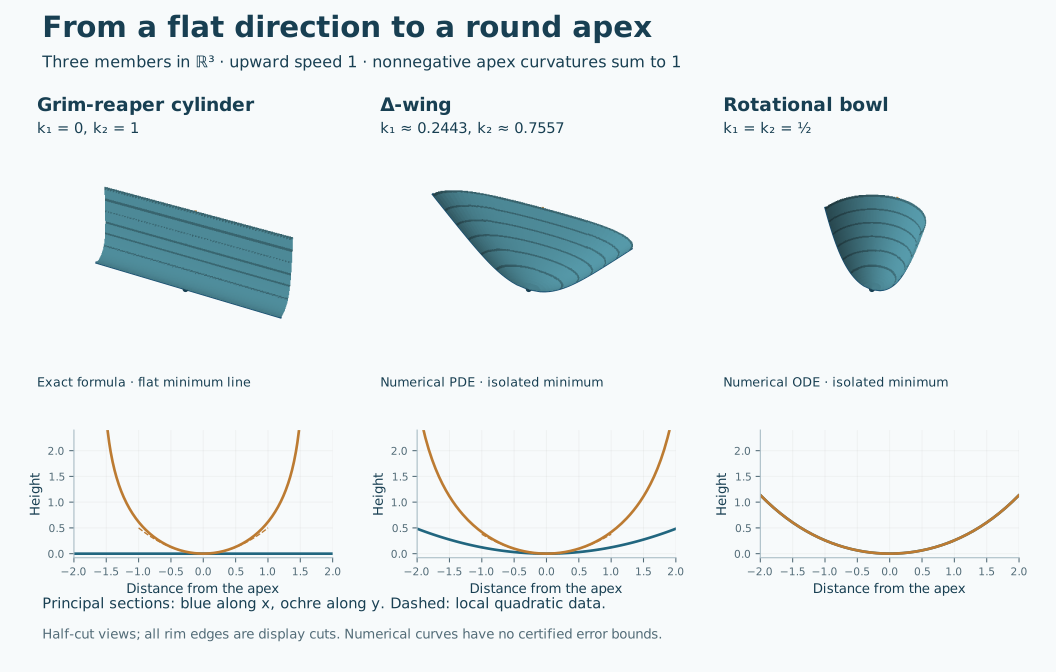
For $n=2$, the figure compares three surface cases in $\mathbb R^3$: $(k_1,k_2)=(0,1)$ gives the grim-reaper cylinder $u(x,y)=-\log \cos y$ on $\mathbb R\times (-\pi /2,\pi /2)$, while $(1/2,1/2)$ gives the rotational bowl. The intermediate picture reuses a numerical $\Delta $-wing on the strip $\mathbb R\times (-\pi /\sqrt2,\pi /\sqrt2)$, obtained by the rectangular Dirichlet construction in Sections 3–4; its measured apex Hessian is approximately $(0.2443,0.7557)$, not an exact prescribed pair. The bowl profile is integrated numerically. All three translate by $t e_3$ for $t\in \mathbb R$. The principal-section view compares the graph with the local Taylor data $\frac12 k_ i s^2$; those parabolas are not global translator formulas. The picture displays surface representatives only, not the higher-dimensional members of Theorem 8.1.
Comments
Comments are not enabled yet.