B5E7AB44607B
The pitchfork is a complete, properly embedded, simply connected, nongraphical translator in $\mathbb R^3$. The supplied notes describe it as a limit of Scherk-type examples, without an explicit formula.
It has genus zero. This distinguishes it from Nguyen's periodic infinite-genus tridents despite their similar asymptotic plane arrangements.
After reflection to upward translation, it is asymptotic to one plane as $z\to -\infty $ and to three parallel planes as $z\to +\infty $. These are height-direction asymptotics, not a claim that the surface has four topological ends.
Its translation yields an eternal noncompact flow. The later construction paper records finite topology and quadratic area growth for its pitchfork subfamily.
See [HIMWNotes19], Section 5 and Figure 7, PDF pages 11–12, and [HMW20]. The existence proof is external. The full construction supplies a pitchfork for each half-width $w\geq \pi $, lying in $|y|<w$. Theorem 1 of [MSTW26] proves uniqueness up to isometry for fixed width in this semigraphical family. Moreover, [GMM25], Theorem 1.5, characterizes pitchforks among complete embedded simply connected translators of finite width, entropy $3$, and containing a vertical line. These hypotheses are essential to the stated classification.
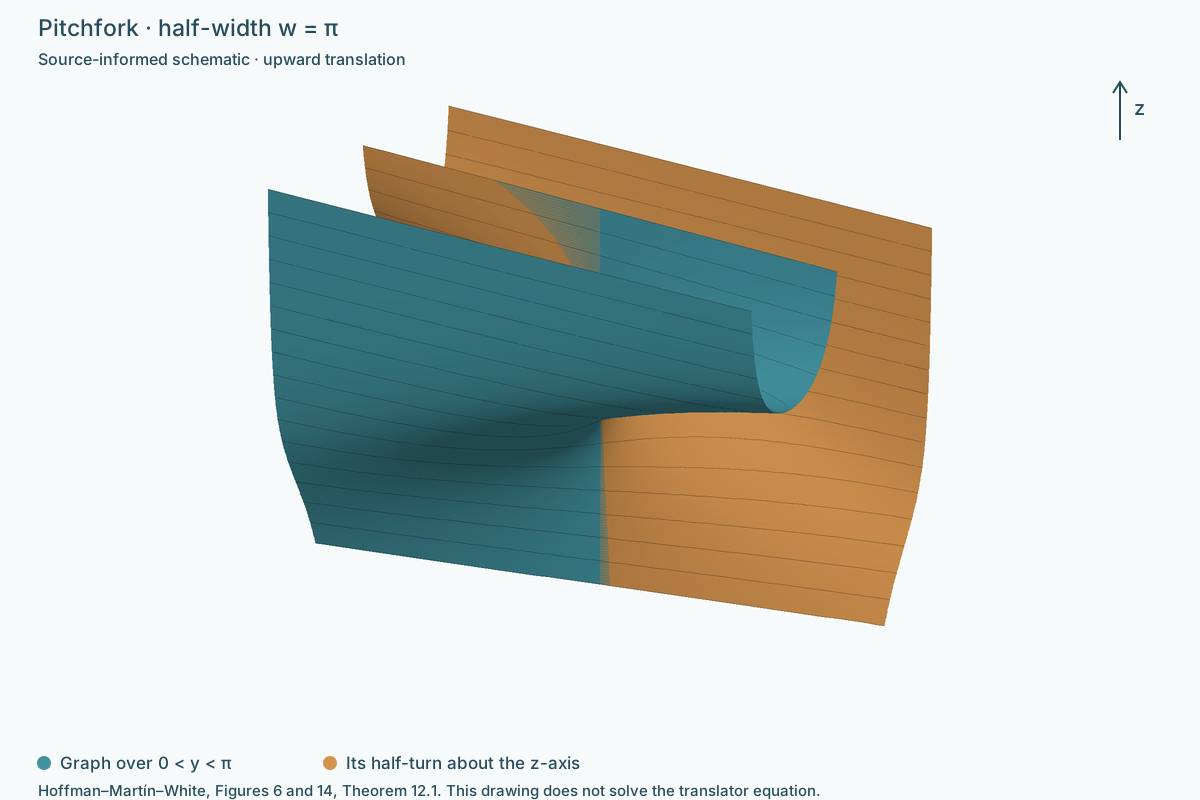
To read the picture, remove the vertical $z$-axis. One component is a graph $z=v(x,y)$ over $\mathbb R\times (0,w)$; the other is its image under $(x,y,z)\mapsto (-x,-y,z)$. In the upward convention the boundary values are
Theorem 12.1 and Corollary 12.2 of [HMW20] give the smooth extension along the axis, negative Gauss curvature, and the planar and tilted-grim-reaper asymptotics. For $w=\pi $, the grim-reaper profile, after vertical recentering at $y=\pi /2$, is $-\log \sin y$ for $0<y<\pi $. This is an asymptotic profile, not a formula for the pitchfork. The interactive drawing illustrates this width using two colored halves and horizontal sections, following Figures 6 and 14 of that paper. Its connecting geometry is schematic, not a computed solution of the translator equation.
Comments
Comments are not enabled yet.