MCF-stack: Special Solutions of Mean Curvature Flow

§ 3.23 Translators with general closed-shrinker endsC44A1D57ECC3

Earliest recorded reference: (first arXiv submission).

Paper credits and chronology

Paper credits are chronological and include every author of the cited papers. They identify sources, not exclusive discovery credit. Background-only citations do not determine the date of this example. A classical example may predate the references recorded here.

  1. Sun–Zhihan Wang — 2023-01-19 (first arXiv submission).
C44A1D57ECC3
191836516CC9

For a closed smooth embedded self-shrinker $S\subset \mathbb R^ n$ of Gaussian Morse index $I$, Sun–Wang construct an $I$-parameter family of complete embedded translators in $\mathbb R^{n+1}$ whose unique tangent flow at backward infinity is $S\times \mathbb R$ with multiplicity one. The construction may have a singular set of dimension at most $n-7$; it is smooth for $n\le 6$, namely ambient dimension at most seven. In higher dimensions it is a weak geometric construction, not an unconditional smooth hypersurface theorem. The Angenent-torus and spherical-doubling input cases have their own existing pages. Additional inputs include other closed embedded high-entropy shrinkers and Riedler's $g=3,4,6$ isoparametric examples. The excluded compact product-of-spheres construction is not used as an input here. The translating flow is $\Sigma +te_ z$, $t\in \mathbb R$. The topology of a cross-sectional shrinker must not be recorded as the genus of the higher-dimensional translator. The theorem specifies the tangent flow, not a literal product end at finite height. The figure shows increasing asymptotic cross-sections and labels the uncomputed core; no arbitrary tube is asserted to solve the translator equation.

Sources: [SunWang2025].
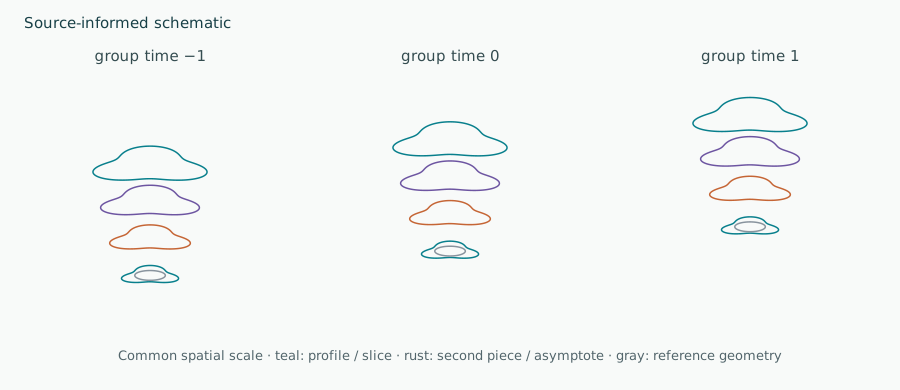
Translators with general closed-shrinker ends. Asymptotic closed-shrinker sections and a marked unresolved core. This is an end diagram, not a tube construction or a numerical translator.
Source-informed schematic. Asymptotic closed-shrinker sections and a marked unresolved core. This is an end diagram, not a tube construction or a numerical translator. Open drawing · Numerical references and credits

Ambient space, topology, embeddedness and entropy

Source construction and dimension restrictions are stated on the reading page. Illustrations have their own accuracy labels.

Smooth construction, n ≤ 6, new inputs starting at n = 3 · Euclidean space ℝ⁴; Euclidean dimension ≥ 5 · Embedded
Ambient space
Euclidean space ℝ⁴; Euclidean dimension ≥ 5
Topology
Complete translator with prescribed closed-shrinker tangent flow; full topology not specified
Embeddedness
Embedded: The cited construction gives an embedding for this case.
Compactness
Noncompact
Surface genus
Not a smooth surface; surface genus is inapplicable.
Topological ends
Not recorded for the full parameter manifold.
Entropy
Not recorded: No quantitative conclusion is recorded from the cited construction.
Gaussian area
Not recorded: No quantitative conclusion is recorded from the cited construction.
n ≥ 7, possible singular set of dimension ≤ n−7 · Euclidean dimension ≥ 5 · Embedded
Ambient space
Euclidean dimension ≥ 5
Topology
Possibly singular minimizing translator
Embeddedness
Embedded: Embedded geometric construction; smoothness may fail on a set of dimension at most n−7.
Compactness
Noncompact
Surface genus
Not a smooth surface; surface genus is inapplicable.
Topological ends
Not recorded for the full parameter manifold.
Entropy
Not recorded: No quantitative conclusion is recorded from the cited construction.
Gaussian area
Not recorded: No quantitative conclusion is recorded from the cited construction.

Compare examples by these properties →

References on this page

  1. [SunWang2025] Ao Sun and Zhihan Wang. On mean curvature flow translators with prescribed ends. Archive for Rational Mechanics and Analysis, 2025. Source locators refer to arXiv version 2, posted 20 August 2025, 45 pages. URL: https://arxiv.org/abs/2301.08224v2, arXiv:2301.08224, doi:10.1007/s00205-025-02125-9.All uses in this project ↩ 1
Cite this page

Comments

Comments are not enabled yet.