MCF-stack: Special Solutions of Mean Curvature Flow

§ 3.7 Finite-genus translators with three ends (Dávila–del Pino–X. H. Nguyen, 2015; Hoffman–Ilmanen–Martín–White, 2019)8609A35E7601

Earliest recorded reference: (first arXiv submission).

Paper credits and chronology

Paper credits are chronological and include every author of the cited papers. They identify sources, not exclusive discovery credit. Background-only citations do not determine the date of this example. A classical example may predate the references recorded here.

  1. Dávila–del Pino–X. H. Nguyen — 2015-01-16 (first arXiv submission).
  2. Hoffman–Ilmanen–Martín–White — 2019-01-25 (first arXiv submission).
8609A35E7601
85D3C19BE7E6

Dávila–del Pino–Nguyen construct complete embedded orientable translating surfaces in $\mathbb R^3$ with finite topology and large genus. The construction desingularizes an intersecting bowl translator and translating catenoid. It is a gluing construction, not an explicit formula.

  • The examples have three asymptotically paraboloidal ends. They are noncompact; their translation gives an eternal flow.

  • The high-genus connecting region replaces a circle of intersection of the model surfaces by a Scherk-like arrangement of small tunnels.

  • The genus restriction is part of the construction: this statement does not supply examples of every prescribed small genus or a uniqueness theorem.

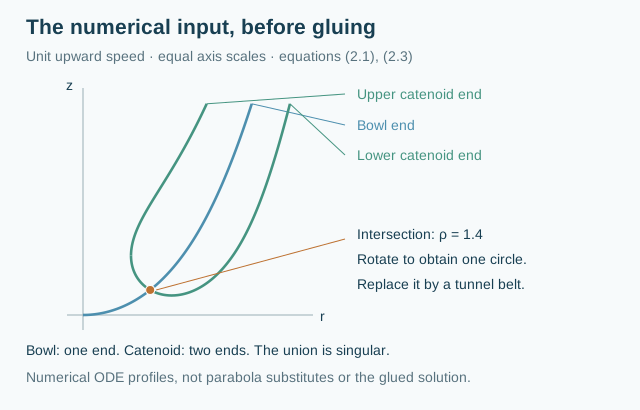
The supplied notes [HIMWNotes19], Section 4, PDF page 11, describe the gluing configuration and the large-genus restriction. The original paper [DPN17], Theorem 1.1, Figure 2, and Section 2, supplies the construction. The illustration separates the numerically integrated bowl–catenoid input from a connected schematic of the tunnel belt. The latter is not a numerical solution of the translator equation. Its period counts are illustrative, and no unproved stability or entropy value is assigned.
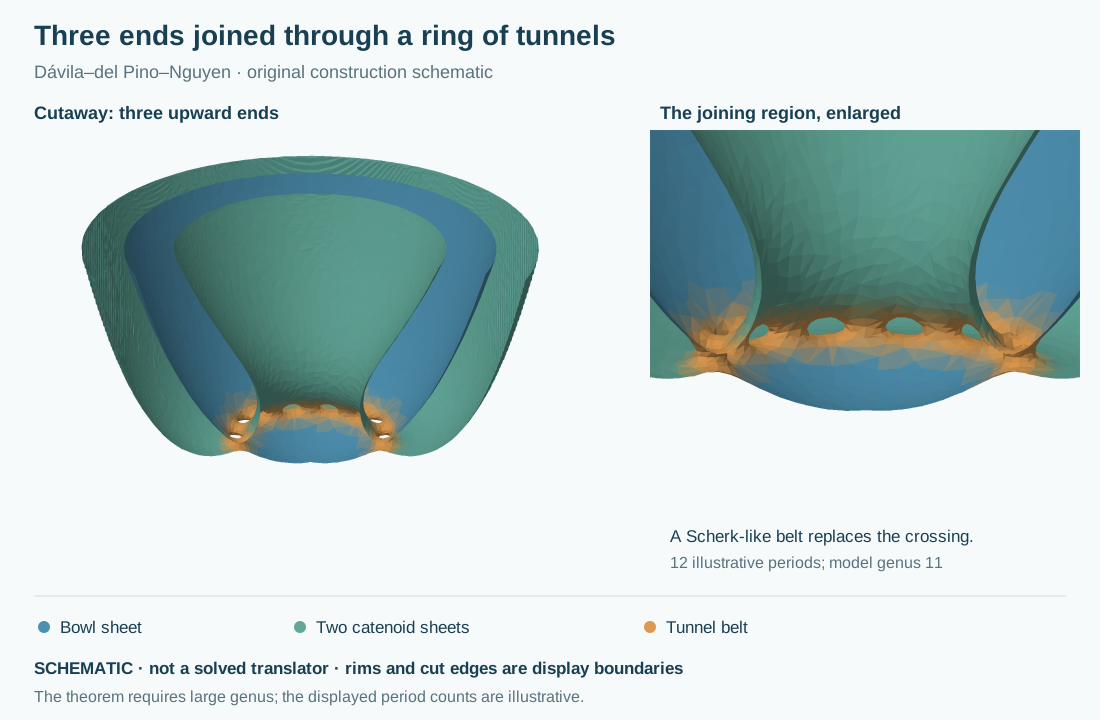
Connected three-ended construction schematic: a blue bowl sheet and two green catenoid sheets joined through a gold tunnel belt, with a cutaway and enlarged tunnel detail. Not a solved translator.
Construction schematic. Three upward ends joined through a Scherk-like tunnel belt, following Dávila–del Pino–Nguyen, Theorem 1.1 and Section 2. Rotate, zoom, inspect the cutaway or tunnel detail, and compare the numerical bowl–catenoid input. The connected model is illustrative; it has not been corrected to solve the translator equation. The displayed period counts do not assert existence at those genera. Open drawing · Numerical references and credits

Equal-scale meridian diagram of a numerical bowl and two-wing translating catenoid with one crossing and three upward ends.
Numerical ODE input. Meridians integrated from the unit-speed rotational translator equations (2.1) and (2.3). The bowl meets the lower wing of the translating catenoid at radius 1.4; revolving this point gives the circle to be desingularized. The height cutoff is artificial. Open drawing · Numerical references and credits
Ambient space, topology, embeddedness and entropy
Orientable surface with three ends · Euclidean space ℝ³ · Embedded
Ambient space
Euclidean space ℝ³
Topology
Orientable surface with three ends
Embeddedness
Embedded: The constructed finite-genus translators are embedded; the intersecting bowl and translating catenoid are construction inputs.
Compactness
Noncompact
Surface genus
Sufficiently large genus
Topological ends
3
Entropy
Not recorded: Not recorded in this entry.
Gaussian area
Not recorded: Not recorded in this entry.

Compare examples by these properties →

References on this page

  1. [HIMWNotes19] David Hoffman, Tom Ilmanen, Francisco Martín, and Brian White. Notes on translating solitons for mean curvature flow. 2019. Supplied 20-page manuscript dated January 29, 2019; catalogue citations use its PDF page numbers, not the later published edition. URL: https://arxiv.org/abs/1901.09101.All uses in this project ↩ 1
  2. [DPN17] Juan Dávila, Manuel del Pino, and Xuan Hien Nguyen. Finite topology self-translating surfaces for the mean curvature flow in R3. Advances in Mathematics, 320:674–729, 2017. Theorem 1.1, Figure 2, and Section 2 checked in the accepted manuscript for the bowl–catenoid and Scherk gluing illustrations. URL: https://arxiv.org/abs/1501.03867, doi:10.1016/j.aim.2017.09.014.All uses in this project ↩ 1
Cite this page

Comments

Comments are not enabled yet.