0F00F9295CD9
In every dimension $n\geq 3$, Xu-Jia Wang constructs entire convex solutions $u:\mathbb R^ n\to \mathbb R$ of the unit-speed upward translator equation
whose level sets are not spheres or round cylinders in any orthogonal coordinate system. This is an existence construction, not an explicit formula.
The graphs are embedded, complete, proper and diffeomorphic to $\mathbb R^ n$; the last three facts also follow directly from being smooth entire graphs. Their flows exist for all $t\in \mathbb R$ by translation.
They are convex and break the spherical or cylindrical rotational pattern of the bowl and its Euclidean products. The corresponding statement for complete entire graphs in $\mathbb R^3$ is false: there the bowl is the only example.
Under spatial blow-down $u_ h(x)=h^{-1}u(\sqrt h\, x)$, Wang's theorem gives, after rotations depending on $h$, a quadratic limit of the form
\[ \frac{x_1^2+\cdots +x_ k^2}{2(k-1)},\qquad 2\leq k\leq n. \]The theorem does not rule out slow rotation of the axes as $h\to \infty $. This is an asymptotic limit, not a formula for $u$.
The same paper also constructs nonrotational complete convex graphical translators over slab regions. No uniqueness theorem for the general higher-dimensional families is claimed here.
For the construction in Section 5, write $x'=(x_1,\ldots ,x_{n-1})$. Wang solves a convex Dirichlet problem on ellipsoids in the Legendre-dual variables, fixes an unequal ratio of the dual level-set widths, and passes to a limit after transforming back. When $n\geq 3$, the choice $\theta >1$ in (5.8) gives an entire solution. This construction retains rotations in $x'$ and reflection in $x_ n$. Wang's term $k$-rotational also requires independence of the other coordinates: partial rotation symmetry alone does not make these examples bowls or bowl products.
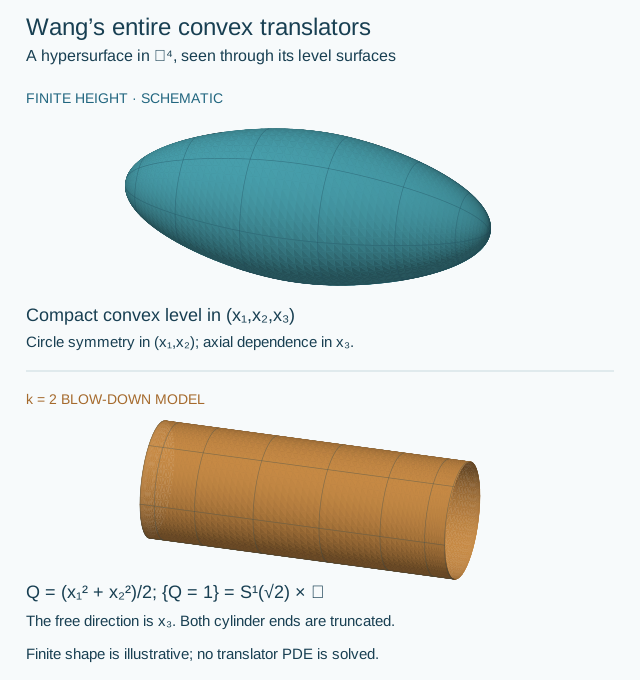
For $n=3$, the graph lies in $\mathbb R^4$, with $x_4=u(x_1,x_2,x_3)$. A horizontal level $\{ u=h\} $ can be drawn in the base $\mathbb R^3$; the construction has bounded sublevel sets by (5.13). The figure uses a convex schematic for these levels and also offers the graph slice $x_2=0$. Its rescaling control illustrates how compact levels can approach a cylindrical level locally while their caps escape. The cylinder $\{ x_1^2+x_2^2=2\} $ is the exact level $Q=1$ of the $k=2$ quadratic model. Neither this quadratic nor the finite drawing formula is a translator solution; the picture selects a permitted limit model without asserting $k=2$ for all examples or a rate of convergence.
See [XJWang11], Theorems 1.2–1.3, printed pages 1187–1188 (PDF pages 3–4), and Section 5, printed pages 1225–1234 (PDF pages 41–50), especially (5.7)–(5.13) and Section 5.3. The translator construction uses $\sigma =1$ in (1.2); the $\sigma =0$ case concerns level-set flow.
Comments
Comments are not enabled yet.