C13AFD802566
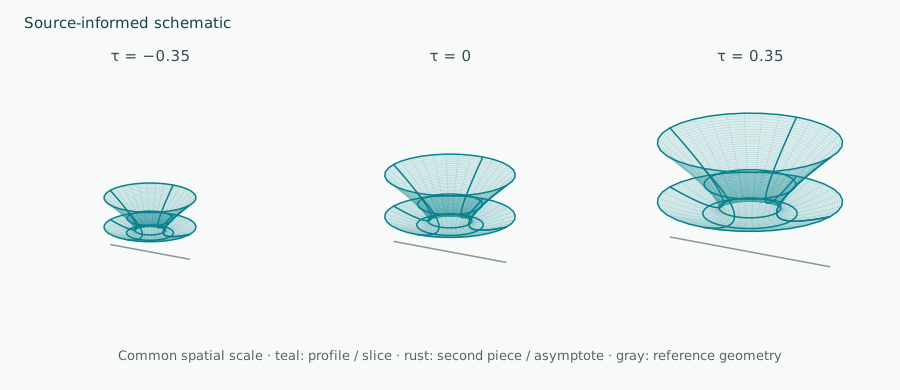
In upper-half-space $\mathbb H^{n+1}=\{ z>0\} $ with metric $z^{-2}(dx^2+dz^2)$, the maps $\Phi _\tau (x,z)=(e^\tau x,e^\tau z)$ are hyperbolic isometries. de Lima–Ramos–dos Santos construct rotational translating catenoids and translation-invariant grim-reaper analogues in $\mathbb H^3$, as well as helicoidal rotators-translators. The 2026 work of de Lima–Ramos supplies rotational catenoid barriers in all dimensions $n+1\ge 3$. These should not be called Euclidean self-expanders: the ambient metric is fixed and the motion is isometric. The rotational examples are properly embedded annuli, with topology $S^{n-1}\times \mathbb R$ and two ends. Their ODE construction and the speed of the generating Killing field are part of the data. The uniqueness statements for the surface catenoids and grim reapers impose the symmetry/asymptotic hypotheses of the cited theorems. Horosphere stability in the later paper concerns radial graphical perturbations with decay; it is not a stability theorem for every catenoid. The figure depicts the rotational and invariant profiles in the half-space model and compares isometric dilation times. Its curves are source-informed schematics, not a computation of the nonlinear profile ODE.
Sources: [LimaRamosSantos2026, LimaRamos2026].
Comments
Comments are not enabled yet.