MCF-stack: Special Solutions of Mean Curvature Flow

§ 3.2 The rotational bowl translator (Clutterbuck–Schnürer–Schulze, 2005; Brendle–Choi, 2017; Hoffman–Ilmanen–Martín–White, 2019; Sun–Zhihan Wang, 2023)38B2DD284E09

Earliest recorded reference: (first arXiv submission).

Paper credits and chronology

Paper credits are chronological and include every author of the cited papers. They identify sources, not exclusive discovery credit. Background-only citations do not determine the date of this example. A classical example may predate the references recorded here.

  1. Clutterbuck–Schnürer–Schulze — 2005-09-16 (first arXiv submission).
  2. Brendle–Choi — 2017-11-02 (first arXiv submission).
  3. Hoffman–Ilmanen–Martín–White — 2019-01-25 (first arXiv submission).
  4. Sun–Zhihan Wang — 2023-01-19 (first arXiv submission).
38B2DD284E09
ECF360A3D482

For each $n\geq 2$, the bowl is the entire graph $z=f(r)$, $r=|x|$ in $\mathbb R^ n$, moving by $z\mapsto z+t$. Its radial profile is specified by the regular ODE

\[ \frac{f''}{1+(f')^2}+\frac{n-1}{r}f'=1,\qquad f(0)=f'(0)=0,\qquad f''(0)=1/n. \]

This is an ODE characterization, not an elementary closed formula.

  • The bowl is complete, properly embedded, strictly convex, rotationally invariant, and diffeomorphic to $\mathbb R^ n$. For $n\geq 2$ it has one topological end and gives an eternal flow.

  • Up to a vertical additive constant, its height has asymptotic expansion

    \[ f(r)=\frac{r^2}{2(n-1)}-\log r+C+O(r^{-1})\quad (r\to \infty ). \]

    A paraboloid is only a leading approximation, not the exact translator.

  • It is unique among entire rotationally invariant translating graphs, up to translation. In $\mathbb R^3$ it is the only complete entire translating graph, up to the natural rigid motions and normalization.

  • In $\mathbb R^3$, Brendle–Choi's theorem characterizes its flow among noncompact, strictly convex, noncollapsed ancient flows, up to scaling and ambient isometries. These are the hypotheses of the cited classification.

  • Graphical weighted stability holds. The stronger dynamical stability theorem of Clutterbuck–Schnürer–Schulze concerns continuous graphical initial data whose height difference from the bowl tends to zero at spatial infinity; the resulting height difference tends uniformly to zero as time tends to infinity.

The supplied notes [HIMWNotes19], Section 4 and Theorem 4.1, PDF pages 10–11, describe the construction and classification. The original ODE and asymptotic analysis is [CSS07], Section 2, Lemmas 2.1–2.2; its Theorem 1.1 gives the stated dynamical stability. The ancient classification is [BrendleChoi19], Theorem 1.1, printed page 36 (PDF page 2). The entropy is $\lambda (\mathrm{Bowl}^ n)=\lambda (S^{n-1}(\sqrt{2(n-1)}))$, in particular $\sqrt{2\pi /e}$ in $\mathbb R^3$. This follows from [SunWang2025], Example 3.6 and Corollary 2.4 with Lemma 2.5, PDF pp. 8–11; it is not an identity for the fixed-center Gaussian area of the bowl.
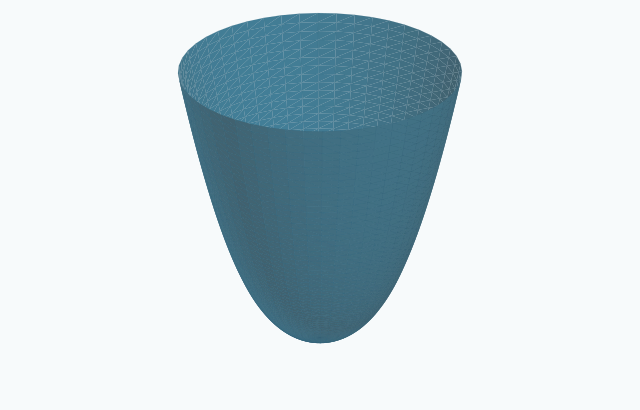
The rotational bowl translator. Numerical integration of the bowl ODE, revolved about its axis; not an exact paraboloid.
Numerical ODE surface. Numerical integration of the bowl ODE, revolved about its axis; not an exact paraboloid. Open drawing · Numerical references and credits

Ambient space, topology, embeddedness and entropy
Surface bowl · Euclidean space ℝ³ · Embedded
Ambient space
Euclidean space ℝ³
Topology
Plane ℝ²
Embeddedness
Embedded: The entire rotational graph is properly embedded.
Compactness
Noncompact
Surface genus
0
Topological ends
1
Entropy
Exact formula: λ = √(2π/e) ≈ 1.52035.
Gaussian area
Not recorded: Not recorded in this entry.
Higher-dimensional bowls · Euclidean space ℝ⁴; Euclidean dimension ≥ 5 · Embedded
Ambient space
Euclidean space ℝ⁴; Euclidean dimension ≥ 5
Topology
Euclidean space ℝⁿ, n ≥ 3
Embeddedness
Embedded: The entire rotational graph is properly embedded.
Compactness
Noncompact
Surface genus
Not a surface
Topological ends
1
Entropy
Exact formula: λ equals the entropy of Sⁿ⁻¹(√(2(n−1))); depends on n.
Gaussian area
Not recorded: Not recorded in this entry.

Compare examples by these properties →

References on this page

  1. [HIMWNotes19] David Hoffman, Tom Ilmanen, Francisco Martín, and Brian White. Notes on translating solitons for mean curvature flow. 2019. Supplied 20-page manuscript dated January 29, 2019; catalogue citations use its PDF page numbers, not the later published edition. URL: https://arxiv.org/abs/1901.09101.All uses in this project ↩ 1
  2. [CSS07] Julie Clutterbuck, Oliver C. Schnürer, and Felix Schulze. Stability of translating solutions to mean curvature flow. Calculus of Variations and Partial Differential Equations, 29(3):281–293, 2007. Citations use the author-hosted September 2005 manuscript, 12 pages. URL: https://www.math.uni-konstanz.de/~schnuere/fub/ocs019.pdf, doi:10.1007/s00526-006-0033-1.All uses in this project ↩ 1
  3. [BrendleChoi19] Simon Brendle and Kyeongsu Choi. Uniqueness of convex ancient solutions to mean curvature flow in R3. Inventiones Mathematicae, 217:35–76, 2019. Supplied journal edition; Theorem 1.1 is on printed page 36, PDF page 2. URL: https://doi.org/10.1007/s00222-019-00859-4, doi:10.1007/s00222-019-00859-4.All uses in this project ↩ 1
  4. [SunWang2025] Ao Sun and Zhihan Wang. On mean curvature flow translators with prescribed ends. Archive for Rational Mechanics and Analysis, 2025. Source locators refer to arXiv version 2, posted 20 August 2025, 45 pages. URL: https://arxiv.org/abs/2301.08224v2, arXiv:2301.08224, doi:10.1007/s00205-025-02125-9.All uses in this project ↩ 1
Cite this page

Comments

Comments are not enabled yet.