MCF-stack: Special Solutions of Mean Curvature Flow

§ 3.24 Su translators obtained by gluing grim cylinders96393C1B9F17

Earliest recorded reference: (first arXiv submission).

Paper credits and chronology

Paper credits are chronological and include every author of the cited papers. They identify sources, not exclusive discovery credit. Background-only citations do not determine the date of this example. A classical example may predate the references recorded here.

  1. Su — 2020-11-16 (first arXiv submission).
96393C1B9F17
164F129D254D

(Lawlor-neck desingularizations of grim cylinders) Fix $m\geq 3$. Let

\[ \gamma _0(u)=-\log \cos u-i(u-\pi /2),\quad |u|<\pi /2,\qquad L_0=\mathbb R^{m-1}\times \gamma _0((-\pi /2,\pi /2))\subset \mathbb C^ m. \]

Choose $\phi _ j\in (0,\pi )$ with $\sum _{j=1}^ m\phi _ j=\pi $, and $\lambda \in \mathbb R$. Define

\[ P_{\phi ,\lambda }(z)=(e^{i\phi _1}z_1,\ldots ,e^{i\phi _{m-1}}z_{m-1},z_ m+\lambda +i\phi _ m). \]

The two grim cylinders meet at one transverse point and satisfy the tangent-plane angle criterion. Su proves that for all sufficiently small $\varepsilon >0$ their intersection can be replaced by a Lawlor neck and then perturbed to a smooth embedded Lagrangian translator $L_\varepsilon $, diffeomorphic to $S^{m-1}\times \mathbb R$. It is complete and proper, with two ends approaching the original cylinder ends in the weighted construction. Its dimension and codimension are $m$. With $e_ m$ the real unit vector in the last complex coordinate,

\[ \vec H=e_ m^\perp ,\qquad L_{\varepsilon ,t}=L_\varepsilon +t e_ m,\qquad -\infty <t<\infty . \]

The parameter $\varepsilon $ is a gluing scale, not flow time. As $\varepsilon \downarrow 0$ the translators converge as currents to $L_0\cup P_{\phi ,\lambda }(L_0)$. The displayed formula is for the building blocks; the perturbed translator has no closed formula. Properness and completeness follow from the small decaying graph on the complete proper ends and the compact neck region.

Source: [Su2022], Main Theorem (p. 3), Sections 3.2–3.4 (pp. 8–10), Section 4.1 (pp. 11–12), and Theorem 6.10 (p. 28). Its Corollary 1.1 also gives examples with arbitrarily many ends and noncontractible loops by finite admissible arrangements of grim cylinders. Those more general topologies are not assigned to this two-ended case. The construction requires the source's $T$-finite condition; it does not establish gluing arbitrary planes to grim cylinders. No uniqueness, entropy value, or dynamical stability is claimed. The pictures specialize to $m=3$, $\phi _1=\phi _2=\phi _3=\pi /3$, and $\lambda =0$. The common point is

\[ p=(0,0,q),\qquad q=-\log \cos (\pi /6)+2\pi i/3. \]

An equal-angle Lawlor neck centered at $p$ can be written, up to its scale, as

\[ p+\bigl (w_\varepsilon (s)\omega _1,w_\varepsilon (s)\omega _2, e^{-2\pi i/3}w_\varepsilon (s)\omega _3\bigr ),\qquad w_\varepsilon (s)=\varepsilon (s+i)^{1/3},\quad s\in \mathbb R,\quad \omega \in S^2, \]

where $0<\arg w_\varepsilon <\pi /3$. The identity $\operatorname {Im}(w_\varepsilon ^3)=\varepsilon ^3$ gives the symmetric special Lagrangian neck; it is a local minimal ingredient, not itself the translator. The drawing uses the slice $\omega _2=0$ and an illustrative interpolation to the exact grim cylinders. This coordinate interpolation does not implement Su's potential gluing or final correction. The projected slice retains $(\operatorname {Re}(e^{-i\beta }z_1),\operatorname {Im}z_3,\operatorname {Re}z_3)$; omitted coordinates can create apparent crossings. The profile view selects $\omega _1=\omega _2=0$, and does not determine the topology of the full translator.

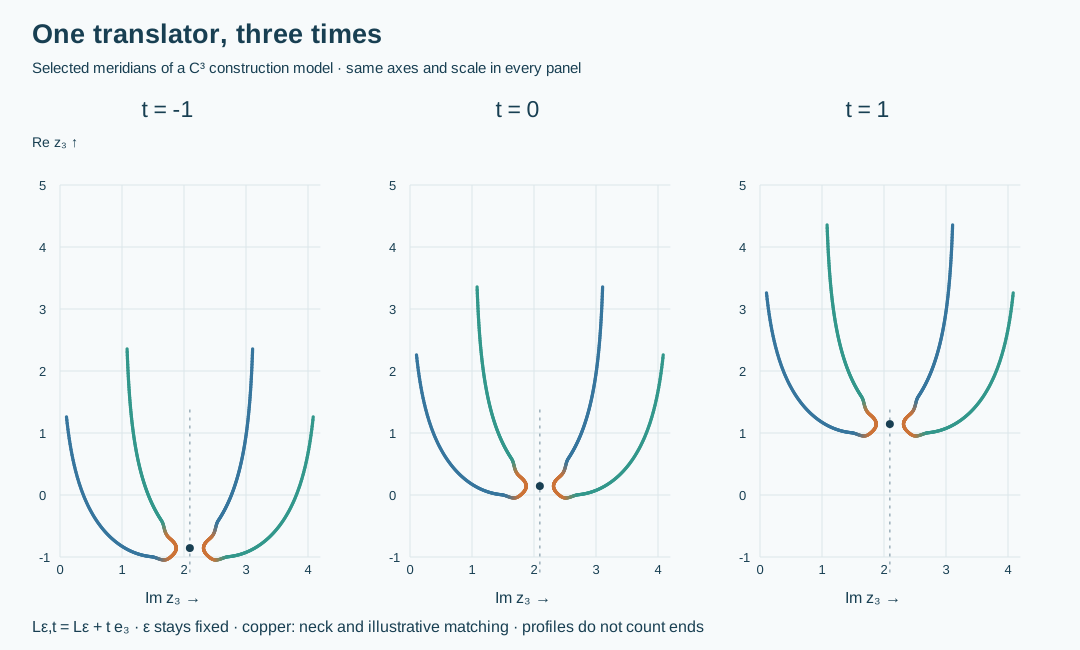
At every time the picture translates by $t$ in $\operatorname {Re}z_3$ with $\varepsilon $ fixed. The frames $t=-1,0,1$ therefore have identical shapes and neck sizes. The existence theorem only supplies a sufficiently small gluing range; the displayed $\varepsilon =0.22$ is illustrative, not a certified member of that range.
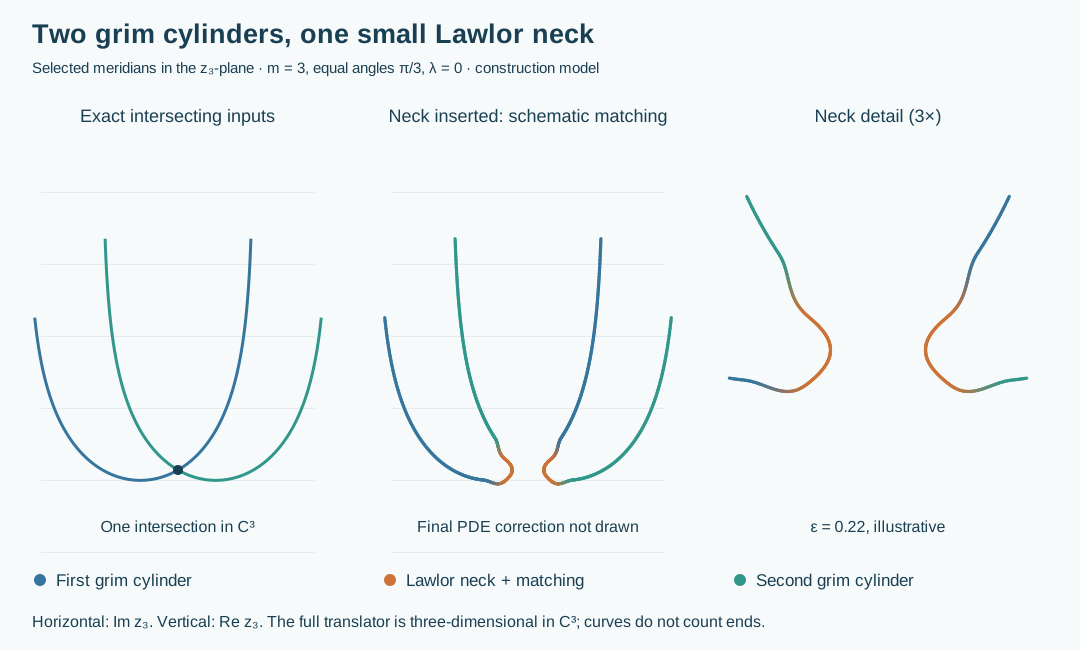
Exact intersecting grim profiles, an illustrative Lawlor-neck replacement, and a magnified neck detail in the z₃-plane.
Projected construction model. Selected meridians and a rotatable projection of a two-dimensional z₂ = 0 model slice in C³. Blue and teal are the grim-cylinder regions; copper is the Lawlor neck and schematic matching. Play the rigid translation at fixed neck scale, inspect the neck, or switch to the projected slice and its cutaway. The final nonlinear correction is not computed. Projection crossings need not be intersections in C³, and all outer rims are display cuts. Open drawing · Numerical references and credits

Three panels with identical grids show the same joined grim profiles shifting upward at times minus one, zero, and one, without changing the neck size.
Time sequence of the construction model. Selected meridians at t = −1, 0, 1 on identical fixed axes. Every point moves by t in Re z₃; the neck scale ε stays fixed. The dotted line follows the translated intersection reference p + t e₃, marked by a dot. The full translator has two ends and topology S² × ℝ; the number of curves in this profile does not count those ends. These are schematic spatial profiles with the exact translation law, not computed solutions of mean curvature flow. Open drawing · Numerical references and credits
Ambient space, topology, embeddedness and entropy

Full Euclidean ambient dimension is 2m, at least six. The illustration uses m = 3, equal angles π/3, and λ = 0; it shows selected meridians and a projected two-dimensional slice of an illustrative gluing model. Projection crossings do not contradict embeddedness in C³. The time views keep the gluing scale fixed and translate by t e₃; no final PDE correction is computed. Auxiliary slices do not determine genus or ends of this higher-dimensional example.

Two-cylinder desingularizations in Cᵐ, m ≥ 3 · Euclidean dimension ≥ 5 · Embedded
Ambient space
Euclidean dimension ≥ 5
Topology
Sᵐ⁻¹ × R
Embeddedness
Embedded: Embedded for this explicitly restricted case; no claim about other weights, groups, or singular limits.
Compactness
Noncompact
Surface genus
Intrinsic dimension at least three; surface genus is inapplicable.
Topological ends
Two ends from the original grim cylinders; higher-end arrangements in Corollary 1.1 are not assigned to this case.
Entropy
Not recorded: No value or bound recorded from the checked source; entropy is not inferred from a single centered Gaussian integral.
Gaussian area
Not recorded: No value or bound recorded from the checked source; entropy is not inferred from a single centered Gaussian integral.

Compare examples by these properties →

References on this page

  1. [Su2022] Wei-Bo Su. On the gluing construction of translating solitons to lagrangian mean curvature flow. 2022. Reviewed edition 2011.07882v2; selected statements checked. URL: https://arxiv.org/abs/2011.07882v2.All uses in this project ↩ 1
Cite this page

Comments

Comments are not enabled yet.