86412C87CEBE
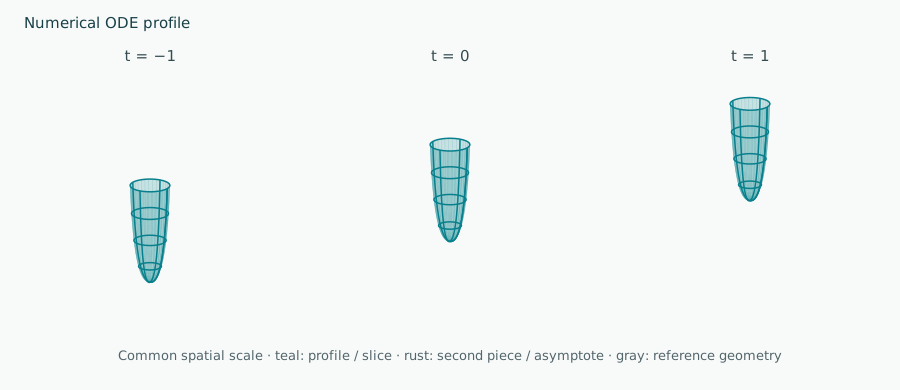
In $\mathbb H^2\times \mathbb R$, with $g=dr^2+\sinh ^2r\, d\varphi ^2+dz^2$, Bueno constructs an entire rotational bowl and a one-parameter family of properly embedded translating catenoids. The bowl is a complete disk; each catenoid is a complete annulus with two graphical ends outside a compact set, parametrized by its positive neck radius. These are intrinsic product-metric examples, not the Euclidean bowl and winglike solitons. The source uses the average of the two principal curvatures. Its unit-speed profile satisfies
Consequently, with the trace mean-curvature vector used by this catalogue, the same surface evolves by $z\mapsto z+2t$, for every $t\in \mathbb R$. The bowl has the smooth axis condition $\theta (r)=r+O(r^3)$; the annuli start at a positive minimum radius with vertical tangent. Uniqueness is within the rotational class and the additional asymptotic hypotheses of the source. Numerical meridians are revolved and displayed in the Poincaré-disk product coordinates $\rho =\tanh (r/2)$; Euclidean-looking distances in this drawing are not intrinsic distances.
Sources: [Bueno2018].
Comments
Comments are not enabled yet.