E6CC94303132
For each $0<w<\pi $, there is a complete properly embedded helicoid-like translator in $\mathbb R^3$. In the downward convention, its fundamental graph over $\mathbb R\times (0,w)$ has alternating infinite boundary values, switching at $(0,0)$ and $(\widehat x,w)$, where $\widehat x>0$ is selected by the solution. Half-turn reflection about the two vertical boundary lines gives horizontal period $2(\widehat x,w,0)$. Reflection in a horizontal plane converts it to $M_ t=M+te_3$, $t\in \mathbb R$.
It is noncompact and has strictly negative Gauss curvature. Successive simply connected strip pieces join along a line in a chain, giving a plane topologically, with genus zero and one topological end. This is a topological deduction from the strip decomposition. Its asymptotic family of parallel vertical planes implies $\lambda (M)=+\infty $. No centered Gaussian-area value is recorded. The axis is oblique to these planes; an ordinary minimal helicoid is not this translator.
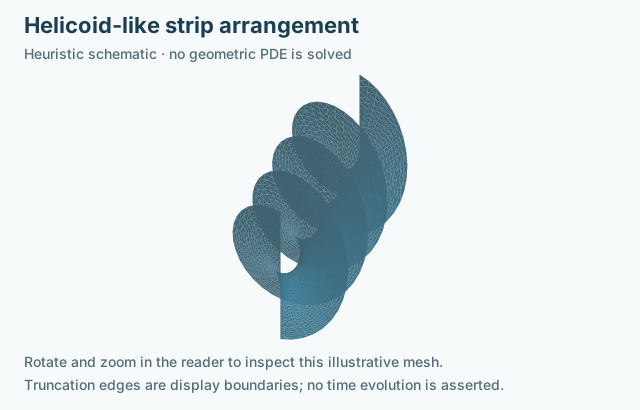
Sources: [HMW20], Theorems 2.3 and 11.1 and Remark 11.2; [MSTW26], Theorem 1 and Section 4, proves uniqueness up to isometry for fixed fundamental width. The earlier paper's open uniqueness question is therefore superseded. The picture shows only the semigraphical arrangement, not a numerical PDE solution.
Comments
Comments are not enabled yet.