96A9DA4F04BF
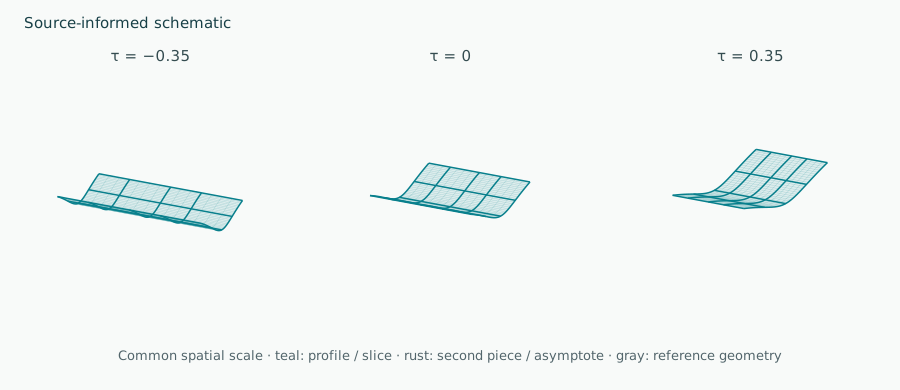
For $\mathrm{Sol}_3$ with metric $e^{2z}dx^2+e^{-2z}dy^2+dz^2$, Pipoli classifies surfaces invariant under a one-parameter isometry group that translate under another Killing field. Write $F_1=\partial _ x$, $F_2=\partial _ y$, $F_3=-x\partial _ x+y\partial _ y+\partial _ z$. For an $F_1$-invariant surface and driving field $V=\eta F_1+\lambda F_2+\mu F_3$, the case $\mu =0$, $\lambda \ne 0$ gives complete graphs over slabs or half-planes, with the asymptotic alternatives in Theorem 1.1. For $\mu \ne 0$ the two components off a distinguished orbit approach a special vertical plane or a logarithmic minimal surface. Mixed horizontal invariance is covered by Theorem 1.2; invariance with a nonzero $F_3$ component forces the stationary minimal alternatives in Theorem 1.3. These graphs include behavior impossible for complete Euclidean graphical translators. Their construction is by profile ODE, not by merely inserting a logarithm into Euclidean space. The eternal motion is the flow of the specified Killing field; for $F_3$ it is $(x,y,z)\mapsto (e^{-t}x,e^ ty,z+t)$. The diagram illustrates this anisotropic isometry on a schematic invariant graph, with the metric and stationary exceptions stated. No common entropy or genus conclusion is assigned beyond the graph cases.
Sources: [Pipoli2019].
Comments
Comments are not enabled yet.