9B1B88A4317F
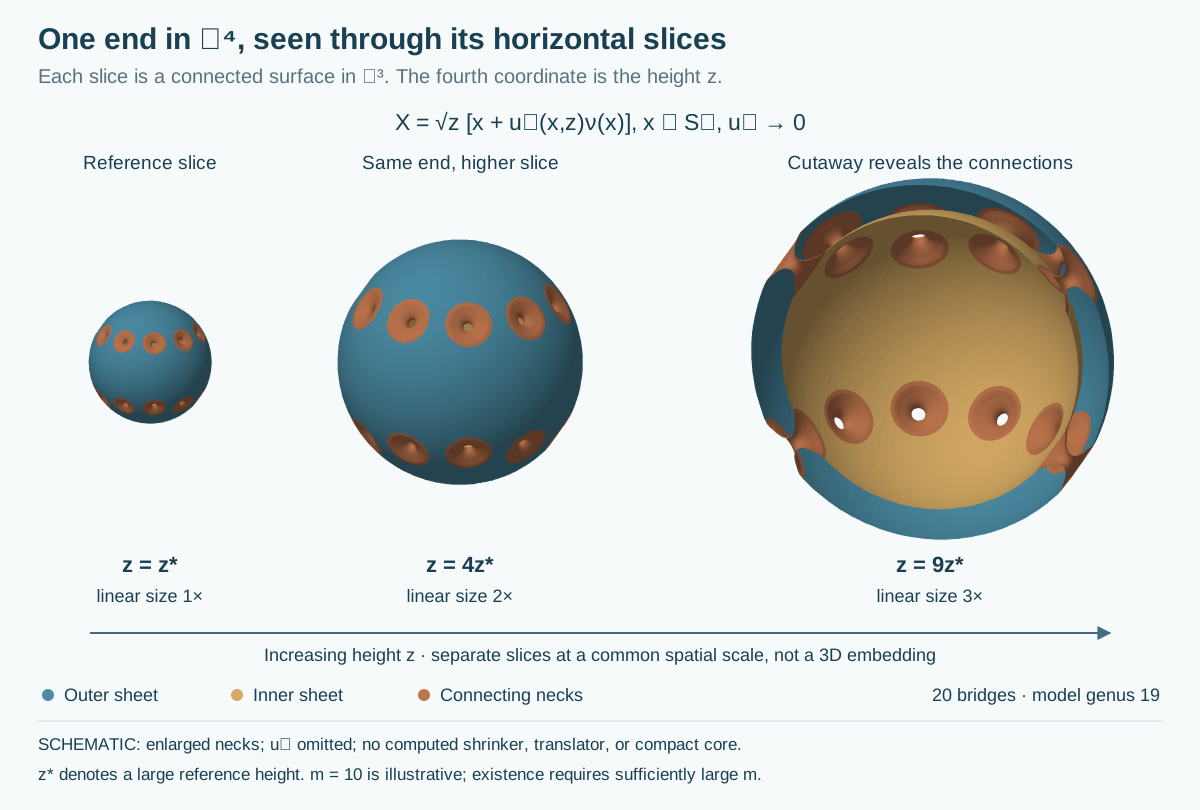
Fix an integer $m$ sufficiently large. In the spherical-doubling construction of Kapouleas–McGrath, choose two latitude circles and $m$ aligned bridge sites on each circle. Their theorem gives a smooth closed embedded shrinker $S_ m\subset \mathbb R^3$, obtained by connecting two nearby copies of the radius-two sphere with $2m$ small catenoidal bridges. Its genus is $2m-1$. This specifies a concrete subfamily of their construction; there is no effective lower threshold for $m$ or explicit formula for $S_ m$ in this statement.
Applying the Sun–Wang construction to $S_ m$ produces complete embedded translators $\Sigma _ m^3\subset \mathbb R^4$ with
and, outside a compact set,
for some $\epsilon _ m>0$. Both the shrinker and the translator are existence constructions; the displayed formula contains an unknown correction and is not an explicit solution.
Each translator is a smooth, complete, properly embedded, noncompact hypersurface, with one end diffeomorphic to $S_ m\times [z_0,\infty )$. The genus $2m-1$ belongs to the two-dimensional horizontal cross-section. No surface genus or complete three-manifold topology is assigned to $\Sigma _ m$.
The unique tangent flow at backward infinity is generated by $S_ m\times \mathbb R$ with multiplicity one. Thus these examples have a different prescribed shrinker from the Angenent-torus-end examples, the bowl, and the previously catalogued three-ended translating surfaces in $\mathbb R^3$.
For each fixed $S_ m$ the end construction has $I_ m=\operatorname {ind}_ F(S_ m)$ parameters before quotienting by ambient translations. The exact index is not computed by the cited construction. One may choose an end and a minimizing completion invariant under the finite symmetry group $\mathcal G_ m=D_{2m}\times \mathbb Z_2$ of order $4m$, where $D_{2m}$ here denotes the dihedral group of order $2m$. Symmetry is asserted for such selected examples, not for every member of the full $I_ m$-parameter family.
The completions are locally $\mathcal I$-minimizing for $\mathcal I=\int e^ z\, d\mathcal H^3$, hence stable for compactly supported variations of that functional. The generic uniqueness result concerns minimizing completions exponentially asymptotic to a fixed constructed end. No specific fattening example for these $S_ m$ is proved in the cited sources.
The entropy is exactly the Gaussian area of the prescribed shrinker:
\[ \lambda (\Sigma _ m)=F(S_ m)=\lambda (S_ m)<2F(S^2(2))=\frac8e. \]The strict upper bound follows by applying the area inequality of Kapouleas–McGrath in the Gaussian metric $g=e^{-|x|^2/4}g_{\rm Euc}$ and dividing its surface area by $4\pi $. It is a consequence of the two cited theorems, not a numerical approximation. No individual numerical entropy or value of $F_{0,1}(\Sigma _ m)$ is recorded.
For the input shrinkers, see [KapouleasMcGrath2023], Theorem 10.5, with $k_\circ =2$ and $\mathbf m=(m)$ (arXiv version 4, PDF page 66), Theorem 9.40 (page 65), and Definitions 7.10–7.11 and Remark 7.12 (page 40). The genus is $|L|-1=2m-1$; smooth embeddedness and the Gaussian-metric area inequality follow from Theorem 5.7 and equation (5.9) (page 30; also Theorem A on page 3). The application to translators uses [SunWang2025], Theorems 3.7 and 4.1 (pages 12 and 28), with compact core and entropy as in Lemma 2.5 and Corollary 2.4 (pages 8–10). This spherical-doubling specialization uses the explicit nondegeneracy check for the radius-two sphere in Section 10; it does not require the separate Angenent-torus doubling theorem of Kapouleas–McGrath.
Comments
Comments are not enabled yet.