E5C494420E4C
For every pitch $h>0$, Halldórsson constructs a one-parameter family of complete immersed helicoidal surfaces in $\mathbb R^3$ that rotate at unit angular speed and, equivalently, translate with velocity $-he_3$. Here pitch means vertical displacement per radian, so one full screw turn rises by $2\pi h$. Source: [Halldorsson2013], Theorem 4.1, equations (3.1)–(3.4), (4.1)–(4.2), PDF pp. 4–9.
Let $s\in \mathbb R$ be arclength on a planar generating curve and solve
Initial data $(\tau ,\nu ,\theta )(0)=(0,d,0)$, $d\geq 0$, select its minimum radius, up to the rotations and orientation changes of the construction. The surface and its eternal evolution are
The same evolving images are $(e^{it}F_{\mathrm{horizontal}},F_3)$; their parametrizations differ by the screw symmetry. With
one has $\vec H=(-he_3)^\perp $. Thus these belong to Translators even though the source also describes them as rotating surfaces. The profiles are ODE-defined, and are different from the helicoid-like translators in Example 3.14.
Each parameter surface is a complete proper immersion of $\mathbb R^2$, of dimension two, codimension one, genus zero, and one intrinsic end. Properness follows from $|X(s)|\to \infty $ as $s\to \pm \infty $ and $F_3=h\phi $. The generating curve has two radially escaping, individually embedded arms; these are not two topological ends of the surface. Both arms wind infinitely, have curvature tending to zero and infinite total absolute curvature, and satisfy $rT/X\to \pm i$. Arms can intersect one another. The centrally symmetric $d=0$ member is embedded; in general the surface is embedded exactly when its planar generating curve is, since its height determines $\phi $. The source exhibits crossings but gives no complete numerical threshold in $(h,d)$ for embeddedness. The displayed normal gives changing sign of $H$, so the surfaces are not mean convex or convex.
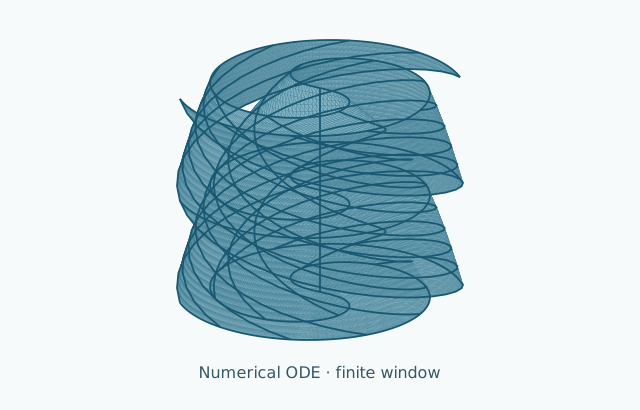
For fixed nonzero $d$ and fixed initial tangent, as $h\to 0$ the generating curves converge on compact arclength intervals to $X_0(s)=id e^{-is/d}$; this is Corollary 4.12, PDF p. 12. It is a limit of profiles: the $h=0$ surface parametrization degenerates and does not define a stationary cylindrical translator. As $h\to \infty $, the profile equation becomes $k=\tau $, giving the rotating curves of Example 5.2 and their product surfaces. No Gaussian-area, entropy or general perturbative stability conclusion is recorded in the cited passages. The viewer shows finite numerical ODE patches, with pitch, profile and time choices; display edges are not boundaries of the complete surfaces.
Comments
Comments are not enabled yet.