MCF-stack: Special Solutions of Mean Curvature Flow

§ 3.34 Grim reapers in the hyperbolic-plane productFB29EFBDEAE7

Earliest recorded reference: (first arXiv submission).

Paper credits and chronology

Paper credits are chronological and include every author of the cited papers. They identify sources, not exclusive discovery credit. Background-only citations do not determine the date of this example. A classical example may predate the references recorded here.

  1. Bueno–López — 2024-02-08 (first arXiv submission).
FB29EFBDEAE7
38A33FD9E29C

Bueno–López classify translation-invariant translating surfaces in $\mathbb H^2\times \mathbb R$. One must specify two pieces of data: the Killing field driving the flow and the one-parameter group preserving each slice. In upper-half-plane coordinates the metric is $(dx^2+dy^2)/y^2+dz^2$, with $y>0$. Vertical, parabolic and hyperbolic motions are respectively $(x,y,z+\tau )$, $(x+\tau ,y,z)$ and $(e^\tau x,e^\tau y,z)$. The possible combinations yield different profile families; a Euclidean grim cylinder is not a substitute for them. The profiles are given by the equations and, in certain cases, explicit parametrizations in Sections 4–6. Their domains, embeddedness and end behavior depend on the chosen case, so no common topology or global completeness claim is assigned to the entire collection. Minimal invariant exceptions are stationary as sets and are not counted as new moving examples. With the source's average scalar curvature, its group parameter is $\tau =2t$ for trace MCF. All complete group orbits extend for $t\in \mathbb R$. The figure compares the three distinct isometry actions on labeled profile schematics; it does not assert a numerical solution of every classification case. The conformal-vector-field examples in Section 7 are not included as Killing translators.

Sources: [BuenoLopez2024].
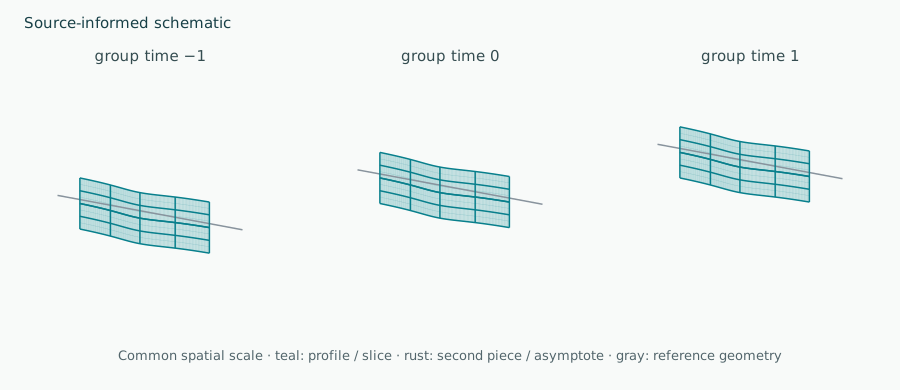
Grim reapers in the hyperbolic-plane product. Select vertical, parabolic or hyperbolic Killing motion in upper-half-plane × height coordinates. Profiles are schematics. A coordinate dilation is an intrinsic isometry, not Euclidean MCF scaling.
Source-informed schematic. Select vertical, parabolic or hyperbolic Killing motion in upper-half-plane × height coordinates. Profiles are schematics. A coordinate dilation is an intrinsic isometry, not Euclidean MCF scaling. Open drawing · Numerical references and credits

Ambient space, topology, embeddedness and entropy

Source construction and dimension restrictions are stated on the reading page. Illustrations have their own accuracy labels.

Vertical, parabolic and hyperbolic Killing cases · Riemannian ambient manifold · Depends on the construction
Ambient space
Riemannian ambient manifold
Topology
Depends on the profile and invariant subgroup
Embeddedness
Depends on the construction: The status depends on the chosen input and closing or quotient conditions.
Compactness
Noncompact
Surface genus
Not recorded.
Topological ends
Depends on the input; asymptotic wings are not automatically topological ends.
Entropy
Not applicable: Euclidean Gaussian area and entropy are not assigned to this intrinsic curved-ambient flow.
Gaussian area
Not applicable: Euclidean Gaussian area and entropy are not assigned to this intrinsic curved-ambient flow.

Compare examples by these properties →

References on this page

  1. [BuenoLopez2024] Antonio Bueno and Rafael López. The class of grim reapers in $\mathbb H^2\times \mathbb R$. arXiv preprint, 2024. URL: https://arxiv.org/abs/2402.05772, arXiv:2402.05772.All uses in this project ↩ 1
Cite this page

Comments

Comments are not enabled yet.