BF18BDD64F8E
Let $S_ A\subset \mathbb R^3$ be an embedded Angenent self-shrinking torus, normalized by $\vec H_{S_ A}=-X^\perp /2$. Sun–Wang construct complete embedded three-dimensional translators $\Sigma \subset \mathbb R^4=\mathbb R^3_ x\times \mathbb R_ z$ satisfying
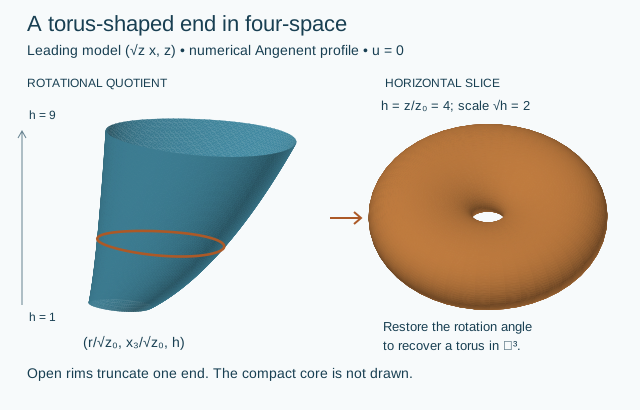
These are variationally constructed hypersurfaces, not explicit parametrized solutions. At sufficiently large height each has the exact graph representation
for some $\epsilon >0$. The unknown function $u$ is solved for by the construction. In particular, the auxiliary expression obtained by setting $u=0$ is not asserted to be a translator.
The translators have codimension one and are smooth, noncompact, complete, and properly embedded. Sun–Wang's general construction can have a singular set of dimension at most $n-7$ for an $n$-dimensional translator in $\mathbb R^{n+1}$; for the present $n=3$ this set is empty.
There is a compact core and one end diffeomorphic to $S_ A\times [z_0,\infty )$. Thus a fixed time slice has one topological end, and its sufficiently high horizontal cross-sections have genus one. The translator is a three-manifold: a surface genus is not assigned to it, and the theorem does not identify its compact core as a solid torus.
Its unique tangent flow at backward infinity is the multiplicity-one shrinking cylinder generated by $S_ A\times \mathbb R$. Equivalently,
\[ R^{-1/2}(\Sigma -R e_4)\longrightarrow S_ A\times \mathbb R \quad \hbox{as }R\longrightarrow \infty . \]This parabolic blow-down cylinder and the single topological end are different notions.
Write $I_ A=\operatorname {ind}_{F}(S_ A)$ for the number of negative eigenvalues of
\[ -L_{S_ A},\qquad L_{S_ A}=\Delta _{S_ A}-\tfrac 12 X^\top \! \cdot \nabla _{S_ A} +|A_{S_ A}|^2+\tfrac 12, \]counted with multiplicity. The translating ends have an $I_ A$-parameter construction, indexed by a ball in $\mathbb R^{I_ A}$ for each sufficiently large cutoff. No exact numerical value of $I_ A$ is needed here. These parameters include ambient translations; they are not a count of parameters after quotienting by rigid motions. The completions need not form a smooth or single-valued family across a fattening parameter. A rotationally invariant subfamily can be chosen.
The chosen completions minimize Ilmanen's weighted area $\mathcal I=\int e^ z\, d\mathcal H^3$ locally with their boundary fixed. Consequently they are stable for compactly supported variations of that weighted functional. This statement is not a claim of entropy stability or dynamical stability under mean curvature flow.
Their entropy is finite and satisfies the exact identity
\[ \lambda (\Sigma )=F(S_ A\times \mathbb R)=F(S_ A)=\lambda (S_ A) =\frac1{4\pi }\int _{S_ A}e^{-|x|^2/4}\, d\mathcal H^2. \]No closed numerical value or value of $F_{0,1}(\Sigma )$ is supplied by this construction.
Nonuniqueness occurs within this same family. There is a rotationally invariant translating end $\Sigma _ e$ for which the associated closed set $T[\Sigma _ e]$ has nonempty interior and
\[ \partial T[\Sigma _ e]=T^+\sqcup T^-. \]The two distinct boundary hypersurfaces are complete smooth embedded $\mathcal I$-minimizing translators, exponentially asymptotic to the same $\Sigma _ e$. Their normalized graph difference decays exponentially in height. This is nonuniqueness of minimizing completions of a fixed end; it is not an assertion that there are exactly two arbitrary translators with that end.
For the fixed ball of ends supplied by the construction, the parameters at which fattening occurs form a meager subset. Off that subset there is a unique $\mathcal I$-minimizing completion exponentially asymptotic to the specified end. The uniqueness statement is restricted to this minimizing class and this asymptotic condition.
The original torus is constructed in [Angenent1992], unnumbered theorem on PDF page 1 of the supplied preprint; its original normalization is converted by multiplying the reference immersion by $\sqrt2$. The translator construction is [SunWang2025], Theorems 1.1 and 3.7 (PDF pages 2 and 12), Theorem 4.1 (page 28), and Theorem 4.3 (pages 32–34). The compact-core and single-end statement follows from Lemma 2.5 and the graphical end description in Lemma 3.2 (pages 9–10). The entropy identity is Corollary 2.4 and Lemma 2.5 (pages 8–9). Fattening and its genericity are Theorem 5.1 (page 35, proved on pages 38–39) and Corollary 4.5 (page 34). The construction is not an exhaustive classification, and its realization as a type-II blow-up of a closed flow is stated as Conjecture 4.6 in that paper.
Comments
Comments are not enabled yet.