B4DA2A79EC96
Castro–Lerma construct Lagrangian translating immersions in $\mathbb C^2$ from pairs of planar soliton curves. In the shrinker–expander case, choose nonvanishing arclength curves $\alpha (s),\omega (u)$ with curvature vectors $\mathbf k_\alpha =-\alpha ^\perp $ and $\mathbf k_\omega =\omega ^\perp $. Their product construction has the integral form
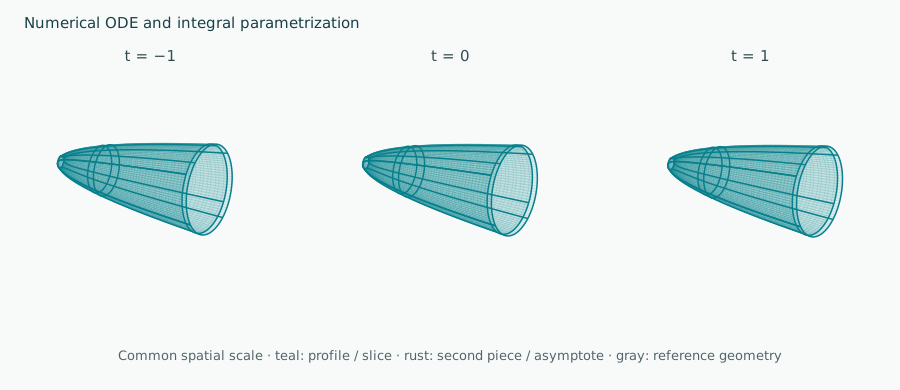
The translator velocity in this normalization is $(1,0)\in \mathbb C^2$. The induced metric is $(|\alpha |^2+|\omega |^2)(ds^2+du^2)$, so complete profile parameters bounded away from simultaneous zero give complete immersions. The more general rotating/dilating curve pairs are treated in Proposition 2; they are not all asserted to be embedded or proper. The flow is $F+t(1,0)$ for $t\in \mathbb R$. Choosing a circular shrinker and a nonstraight expander provides a concrete numerical example. The already listed Hamiltonian-stationary translator and Joyce–Lee–Tsui overlap are not new examples here. The visualized two-dimensional sheet is a projection from four real dimensions, with coordinate choice shown in the controls.
Sources: [CastroLerma2012].
Comments
Comments are not enabled yet.