MCF-stack: Special Solutions of Mean Curvature Flow

§ 3.4 Periodic translating tridents (X. H. Nguyen, 2009; Hoffman–Ilmanen–Martín–White, 2019; Hoffman–Martín–White, 2019)31505E08B028

Earliest recorded reference: (publication year).

Paper credits and chronology

Paper credits are chronological and include every author of the cited papers. They identify sources, not exclusive discovery credit. Background-only citations do not determine the date of this example. A classical example may predate the references recorded here.

  1. X. H. Nguyen — 2009 (publication year).
  2. Hoffman–Ilmanen–Martín–White — 2019-01-25 (first arXiv submission).
  3. Hoffman–Martín–White — 2019-09-19 (first arXiv submission).
31505E08B028
27C982677562

Nguyen's tridents are complete periodic embedded translating surfaces in $\mathbb R^3$ obtained by desingularizing a grim-reaper cylinder and a plane. We use unit upward velocity $e_3$, so $M_ t=M_0+t e_3$ for all $t\in \mathbb R$. There is no explicit global formula for the completed translator.

  • They are noncompact and have infinite genus. A repeating row of Scherk saddle connections resolves the intersection; the intersecting input surfaces are not themselves a trident.

  • In the upward convention there is one asymptotic plane as $z\to -\infty $ and three parallel asymptotic planes as $z\to +\infty $. These describe height-direction asymptotics, not a count of topological ends of the full periodic surface.

  • Nguyen's construction applies at sufficiently small positive scales. The later semigraphical construction agrees with these examples in that range; its tridents are properly embedded and have entropy $3$ [HMWTridents22], Theorem 1 and pp. 2–3. This entropy is not identified with centered Gaussian area.

The local minimal ingredient is $\sin v=\sinh u\sinh w$, with $(u,v,w)\in \mathbb R^3$ and period $2\pi $ in $v$. Its four wings are attached to two planar wings and two grim-reaper wings. In the unit upward convention the limiting inputs are $z=-\log \cos y$, $|y|<\pi /2$, $x\in \mathbb R$, and the plane $y=0$. See [Nguyen09], Theorem 1, Sections 1.2–1.4 and Section 2 (Definitions 4–5), and [HMWTridents22], Figures 1–2. The latter figures use downward translation; here height is reflected.

The interactive picture is an original smooth deformation of the Scherk ingredient, with three periods shown. Its half-surface view exposes the saddle connections. Its neck scale is a drawing parameter: the unbalancing, cutoff matching, and final nonlinear correction in Nguyen's proof have not been computed. In particular, its fixed illustrative half-width $\pi /2$ is the limiting input width, not the width of a finite-period trident. See [HIMWNotes19], Sections 4–5, for the survey comparison with the simply connected pitchfork.
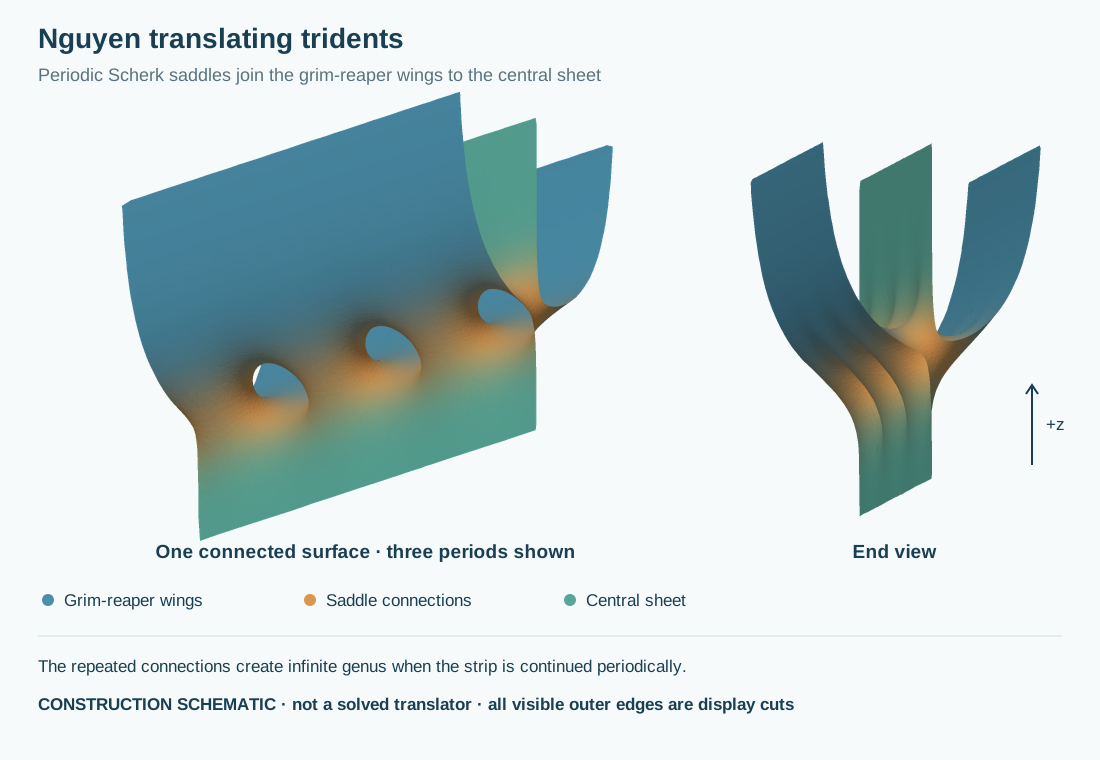
Connected trident construction schematic with a row of saddle connections. Two grim-reaper wings rise beside a central sheet; the strip repeats periodically.
Construction schematic. One connected Scherk-based drawing with periodic saddle connections, grim-reaper wings, and a central sheet. Rotate, inspect a half surface, or inspect an end view. The displayed neck scales are illustrative; the drawing does not solve the translator equation. All outer edges are display cuts. Open drawing · Numerical references and credits

Ambient space, topology, embeddedness and entropy

The picture is a construction schematic. Its neck scale and limiting half-width do not specify a computed translator. One lower and three upper limiting planes are height-direction asymptotics, not a topological end count.

Periodic surface of infinite genus · Euclidean space ℝ³ · Embedded
Ambient space
Euclidean space ℝ³
Topology
Periodic surface of infinite genus
Embeddedness
Embedded: Complete and properly embedded periodic tridents; Nguyen’s small-scale examples coincide with the semigraphical family by Hoffman–Martín–White, Theorem 1 and p. 2. The intersecting plane and grim cylinder are limiting inputs.
Compactness
Noncompact
Surface genus
Infinite genus
Topological ends
Not recorded
Entropy
Exact formula: λ = 3; Hoffman–Martín–White, arXiv:1909.09241v2, p. 3. Not inferred from the drawing or equated with F₀,₁.
Gaussian area
Not recorded: Not recorded in this entry.

Compare examples by these properties →

References on this page

  1. [HMWTridents22] David Hoffman, Francisco Martín, and Brian White. Nguyen's tridents and the classification of semigraphical translators for mean curvature flow. 2022. Reviewed 26-page arXiv v2 edition, revised December 29, 2021, posted February 1, 2022. Theorem 1 and Figures 1–2, pages 1–3. Downward translation convention. URL: https://arxiv.org/abs/1909.09241v2.All uses in this project ↩ 1 ↩ 2
  2. [Nguyen09] Xuan Hien Nguyen. Translating tridents. Communications in Partial Differential Equations, 34(3):257–280, 2009. Original construction reviewed in the author-posted manuscript: Theorem 1, Sections 1–2 and Section 5. Author manuscript pagination differs from the journal edition. URL: https://doi.org/10.1080/03605300902768685, doi:10.1080/03605300902768685.All uses in this project ↩ 1
  3. [HIMWNotes19] David Hoffman, Tom Ilmanen, Francisco Martín, and Brian White. Notes on translating solitons for mean curvature flow. 2019. Supplied 20-page manuscript dated January 29, 2019; catalogue citations use its PDF page numbers, not the later published edition. URL: https://arxiv.org/abs/1901.09101.All uses in this project ↩ 1
Cite this page

Comments

Comments are not enabled yet.