C6C5A44F27CC
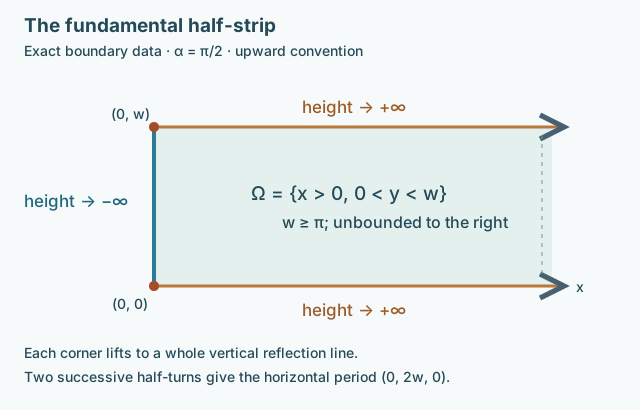
Hoffman–Martín–White construct Scherkenoids for $0<\alpha <\pi $ and $w\geq \pi $ as complete, properly embedded, singly periodic translator surfaces in $\mathbb R^3$; see [HMW20], Theorems 2.3 and 9.2. In the catalogue's upward convention, the fundamental piece is the graph of $U$ over
with $U\to +\infty $ on the two horizontal rays and $U\to -\infty $ on the finite slanted edge. The graph closes along the two vertical lines above the corners. Repeated half-turns about those lines produce the complete surface, with period $2(w\cot \alpha ,w,0)$. This is a boundary-value construction, not a closed formula for $U$.
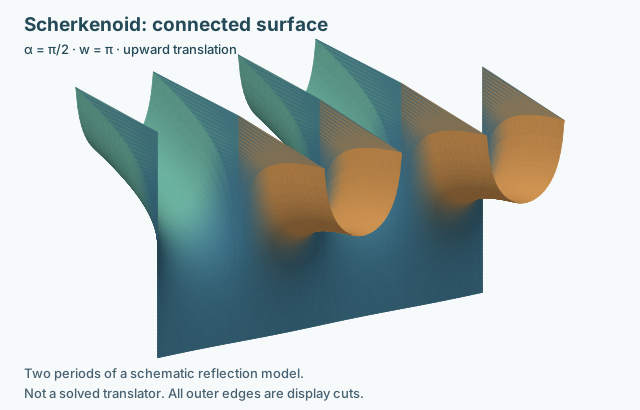
The connected illustration fixes $\alpha =\pi /2$ and allows $w$ to vary. It shows how a single central sheet opens into alternating wings. Far along a wing, after recentering height, the limiting graph has the explicit profile
This formula describes the tilted grim-reaper limit, not the whole Scherkenoid. For $w=\pi $ the tilt vanishes. In the upward convention, the height limits are the plane $x=y\cot \alpha $ as $z\to -\infty $ and the planes $y=nw$, $n\in \mathbb Z$, as $z\to +\infty $.
The drawing follows Figures 5 and 11 and Section 9 of [HMW20], arXiv version 4, pages 7 and 26–30. Its joining profile is schematic, not a numerical solution of the translator equation. The paper uses downward velocity; reflecting height gives the upward flow $M_ t=M+t e_3$ for all $t\in \mathbb R$. See also the earlier survey [HIMWNotes19], Section 5. No stability or entropy conclusion is inferred from the drawing.
Comments
Comments are not enabled yet.