72E3A9DEA98C
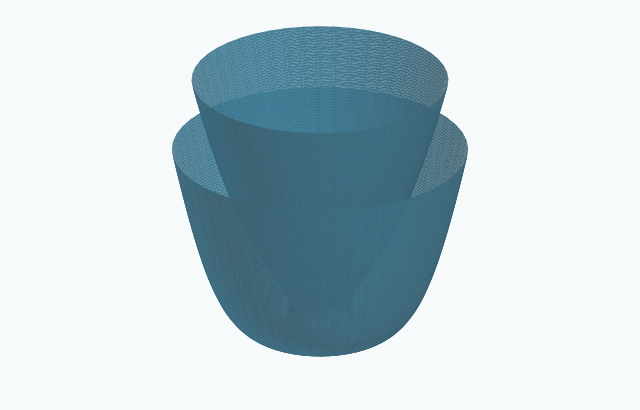
For every neck radius $R>0$ and $n\geq 2$, there is a rotational translating hypersurface with two ends. These are also called winglike translators. They move upward with unit speed. A convenient numerical description uses meridian arclength $s$ and tangent angle $\alpha $:
Revolution gives $(r(s)\omega ,z(s)+t)$ with $\omega \in S^{n-1}$ and $t\in \mathbb R$. The arclength system is obtained from $\vec H=e_{n+1}^{\perp }$ and is not a closed formula.
The surface is complete, embedded, noncompact and nonconvex, with topology $S^{n-1}\times \mathbb R$. In $\mathbb R^3$ it is an annulus, not an entire graph.
Outside the neck the two ends are radial graphs. Each has expansion
\[ f_\pm (r)=\frac{r^2}{2(n-1)}-\log r+C_\pm +O(r^{-1}). \]In particular the two ends go to spatial infinity and the complete surface is proper.
The parameter controls the neck radius. The supplied survey describes the limiting double bowl with a singular point on the axis as the neck parameter tends to zero.
See [HIMWNotes19], Section 4, PDF page 10. The original construction and end expansion are [CSS07], Lemma 2.3, PDF pages 5–7 of the author preprint. No uniqueness beyond the radial initial-value construction, nor an entropy or stability classification for this non-graphical surface, is asserted here.
Comments
Comments are not enabled yet.