4F35D93CA4BD
(Disconnected double-cone smoothings) Let $n\geq 2$, write $(x,z)\in \mathbb R^ n\times \mathbb R$, and let
With $\phi _{\cot \alpha }$ from Example 4.7, the two-sheeted expander is
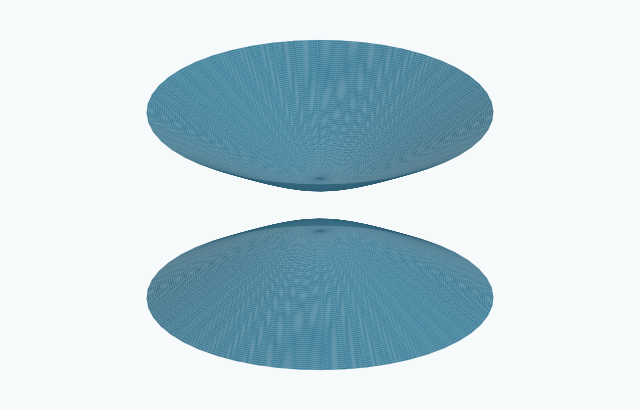
This display specifies the surface using ODE-defined functions. Its two components are smooth, complete, properly embedded convex entire graphs, each diffeomorphic to $\mathbb R^ n$. The union is noncompact, invariant under rotations about the $z$-axis and under $z\mapsto -z$, and has two oppositely directed conical ends. The flow $\sqrt t\, M_\alpha ^{(2)}$, $t>0$, approaches $D_\alpha $ as $t\downarrow 0$.
Existence and uniqueness of each rotational single-lobe graphical profile are established in [AIC95], Lemma 2(i), printed p. 1947, supplied PDF p. 12. Theorem 4, printed pp. 1950–1951, PDF pp. 15–16, provides a critical angle $\alpha _{\rm crit}(n+1)\in (0,\pi /2)$. For $\alpha <\alpha _{\rm crit}(n+1)$ the level-set flow of the double cone is exactly the two-sheeted flow. For angles above this threshold there are also connected smoothings, so the graphical uniqueness statement does not assert uniqueness among all flows from the cone. The critical-angle decimal estimates later in that paper are numerical. The $n=2$ figure rotates two reflected numerical profiles; the cone is their asymptotic limit.
Comments
Comments are not enabled yet.