MCF-stack: Special Solutions of Mean Curvature Flow

§ 4.18 Lee–Wang embedded quadric expanders3A7601A9FD31

Earliest recorded reference: (first arXiv submission).

Paper credits and chronology

Paper credits are chronological and include every author of the cited papers. They identify sources, not exclusive discovery credit. Background-only citations do not determine the date of this example. A classical example may predate the references recorded here.

  1. Lee–Mu-Tao Wang — 2008-02-04 (first arXiv submission).
3A7601A9FD31
A1A5802C8577

(The expanding mixed-sign quadric family) For $n\geq 3$, $n/2<k<n$, and $S=2k-n$, set

\[ Q_-=\left\{ x\in \mathbb R^ n:\sum _{j\leq k}x_ j^2-\sum _{j>k}x_ j^2=-2S\right\} ,\qquad X(x,s)=(e^{is}x_1,\ldots ,e^{is}x_ k,e^{-is}x_{k+1},\ldots ,e^{-is}x_ n). \]

On $(Q_-\times \mathbb R)/((x,s)\sim (-x,s+\pi ))$ this is a complete proper embedded Lagrangian in $\mathbb C^ n$, of dimension and codimension $n$. It satisfies $\vec H=X^\perp /2$, and $L_ t=\sqrt t\, X(Q_-\times \mathbb R)$ for $t>0$. This is an exact parametrization subject to one quadric constraint, not an ODE approximation. See [LeeWang2010], Propositions 2.1–2.2, with weights $+1$ and $-1$.

The fiber is $\mathbb R^ k\times S^{n-k-1}$. The mapping-torus quotient is connected and has one end. If $n-k=1$, its two fiber components are exchanged by the gluing, and the total manifold is diffeomorphic to $\mathbb R^ k\times S^1$, hence orientable. For $n-k\geq 2$ the fiber is connected, the antipodal monodromy must be retained, and the total manifold is orientable exactly when $n$ is even. In particular, the $n=3,k=2$ case is orientable: one must pass around the base twice to return to the same component. These topology statements are obtained from the quotient directly; the product and parity shorthand in the source's Proposition 2.2 requires this disconnected-fiber qualification.

The family is noncompact and Hamiltonian stationary, with $SO(k)\times SO(n-k)$ and circle symmetries, and is asymptotic to the same cone as Example 2.50. Its planar-coordinate quadric description gives polynomial volume growth and finite centered Gaussian area; this entry records no entropy value or stability result. No surface genus is assigned to these $n\geq 3$ examples. The source's weak continuation at $t=0$ is a separate varifold statement; the smooth time interval here is $t>0$.

For the illustrated case $n=3$, $k=2$, the full expander has the global parametrization

\[ F_ t(a,b,s)=\left(e^{is}a,e^{is}b,e^{-is}\sqrt{a^2+b^2+2t}\right), \qquad (a,b)\in \mathbb R^2,\quad s\in \mathbb R/(2\pi \mathbb Z),\quad t>0. \]

This parametrization is obtained directly from the unit-weight construction in [LeeWang2010], Theorem 1.1 and Section 2.2: one takes the positive component of the real quadric and a full circle of phases. The real slice, obtained at $s=0$ and $s=\pi $, consists of the two graphs

\[ x_3=\pm \sqrt{r^2+2t},\qquad r=\sqrt{x_1^2+x_2^2}\geq 0. \]

Their tips are at $x_3=\pm \sqrt{2t}$. The figure compares $t=1/4,1,4$ with the singular cone limit $t=0$, using the same spatial scale and the fixed display cutoff $r\leq 3.2$. The complete slices are unbounded. These are exact two-dimensional slices of a three-dimensional flow in $\mathbb R^6$; they are not themselves mean curvature flows in $\mathbb R^3$.

The circle direction explains why two real sheets do not mean two components of the expander. For a point $x=(x_1,x_2,x_3)$ on the positive real sheet, the curve

\[ \gamma _ x(s)=\left(e^{is}x_1,e^{is}x_2,e^{-is}x_3\right) =\cos (s)x+\sin (s)i(x_1,x_2,-x_3),\qquad 0\leq s\leq \pi , \]

lies in $L_ t$ and joins $x$ to $-x$ on the other real sheet. It is a semicircle in a real two-plane in $\mathbb R^6$, since the two spanning vectors are orthogonal and have equal length. The circle-phase control follows this path at fixed time; only the time control changes the flow.
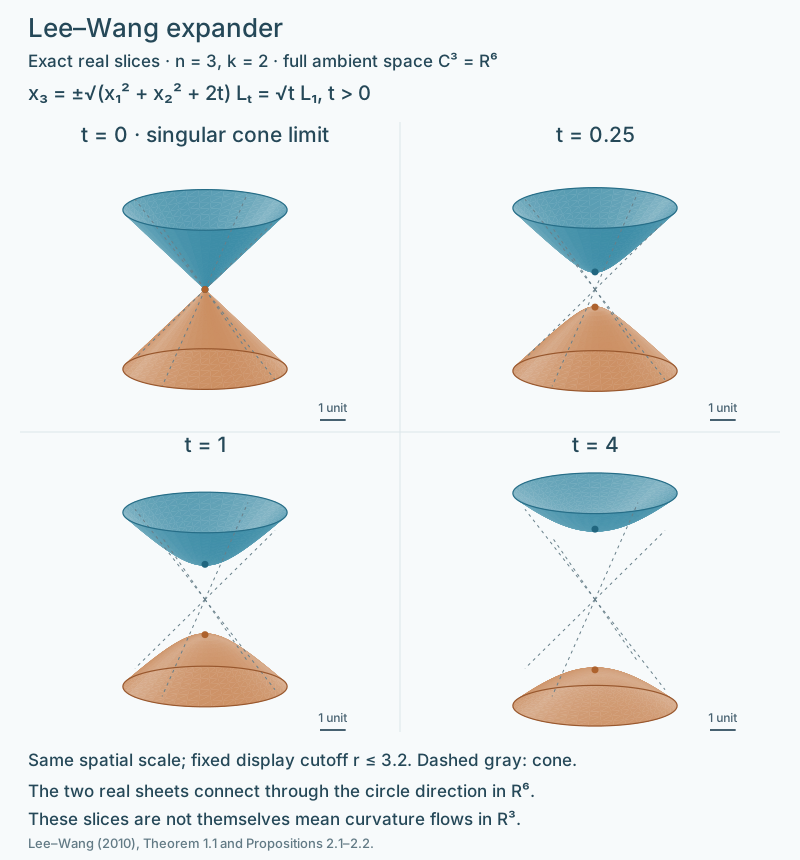
Exact two-sheeted real quadric slices at four times with one common scale, and an exact circle orbit explaining their connection in the full expander in R6.
Exact time slices and circle orbit. The n = 3, k = 2 expander in C³ = R⁶. Compare the exact real slices x₃ = ±√(x₁² + x₂² + 2t) at t = 0, 1/4, 1, 4 on the same spatial scale, or play the positive-time flow. The t = 0 panel is the singular cone limit. The circle-orbit view joins the two real sheets within one connected three-manifold at fixed time. These slices do not themselves solve mean curvature flow in R³; outer rims are display cutoffs. Open drawing · Numerical references and credits

Ambient space, topology, embeddedness and entropy

Full Euclidean ambient dimension is 2n or 2m, at least six. Auxiliary slices and curves do not determine the genus of this higher-dimensional example.

Embedded unit-weight expanders in Cⁿ, n ≥ 3, n/2 < k < n · Euclidean dimension ≥ 5 · Embedded
Ambient space
Euclidean dimension ≥ 5
Topology
Mapping torus of Rᵏ × Sⁿ⁻ᵏ⁻¹ under antipodal gluing; Rᵏ × S¹ when n − k = 1.
Embeddedness
Embedded: Embedded for this explicitly restricted case; no claim about other weights, groups, or singular limits.
Compactness
Noncompact
Surface genus
Intrinsic dimension at least three; surface genus is inapplicable.
Topological ends
One end; two fiber components in the n − k = 1 case are joined by the gluing.
Entropy
Not recorded: No value or bound recorded from the checked source; entropy is not inferred from a single centered Gaussian integral.
Gaussian area
Finite; value not recorded: Finite by the explicit quadric geometry and polynomial volume growth; no value recorded.

Compare examples by these properties →

References on this page

  1. [LeeWang2010] Yng-Ing Lee and Mu-Tao Wang. Hamiltonian stationary cones and self-similar solutions in higher dimension. 2010. Reviewed edition 0802.0359v1; selected statements checked. URL: https://arxiv.org/abs/0802.0359v1.All uses in this project ↩ 1 ↩ 2
Cite this page

Comments

Comments are not enabled yet.