4D33C840252C
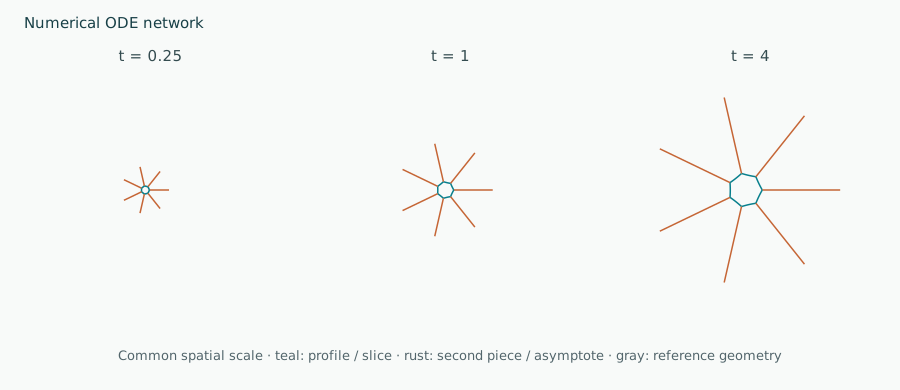
In the equal-tension case, Chen–Guo construct a regular self-expanding planar network with one bounded central cell and $k$ exterior rays for every integer $k\ge 7$. Every junction has angle $120$ degrees. The global existence condition in their Theorem 2 is $\sum _ i\psi _{i,i+1}>2\pi $; equal tensions give $\psi _{i,i+1}=\pi /3$, hence exactly $k>6$ for this construction. Six sides belong to the stationary limiting balance and do not give a nontrivial expander of this type. In our normalization the branches satisfy $\mathbf k=X^\perp /2$ and the flow is $\sqrt t\, \Gamma $, $t>0$. This network has a cycle and is not covered by the planar-tree entry. The source proves uniqueness within its prescribed contact-angle and radial-interface ansatz, not among all networks with the same number of ends. The parameter graph is complete and embedded with its prescribed junctions; it has $k$ ends and finite Gaussian area and entropy. Our numerical shooting constructs the symmetric seven-sided example, with radial exterior rays. A changing side count changes the family member; the time slider only applies homothety.
Sources: [ChenGuo2007].
Comments
Comments are not enabled yet.