3A8C3B21B572
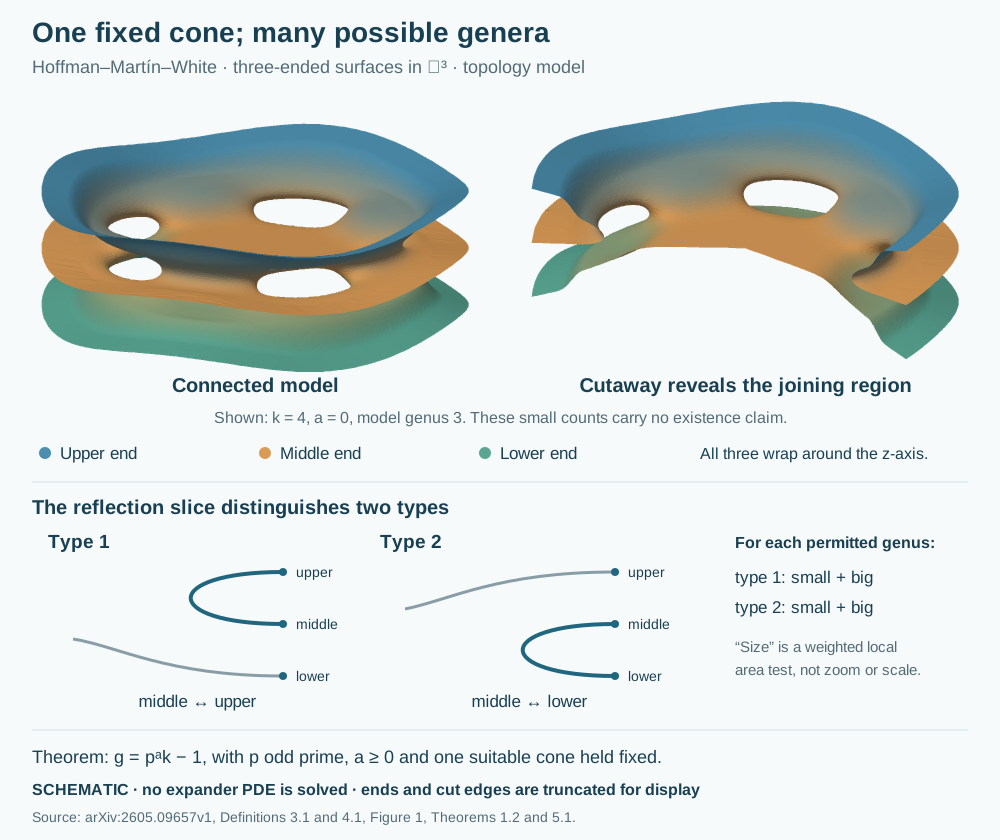
Hoffman–Martín–White construct connected embedded self-expanders in $\mathbb R^3$ of arbitrarily large genus at a single suitable cone. Precisely, let $C=C_ k$ satisfy the symmetry and three-component link hypotheses of their Theorem 1.1, with its spherical link sufficiently close to the equatorial plane as required in Theorem 1.2. For each odd prime $p$ and integer $a\geq 0$, there are at least four noncongruent $G_ k$-invariant expanders asymptotic to $C$, of genus $p^ a k-1$.
These are complete proper noncompact surfaces with three conical ends; the end count follows from the three components of the link. They solve $\mathbf H=X^\perp /2$ and yield $\sqrt t\, E$ for $t>0$. They are obtained by degree theory and limiting constructions, not an explicit formula. No common convexity, stability, or numerical entropy value is asserted. Smooth conical ends imply finite Gaussian area and entropy.
The incoming shrinker $M_ k$ has genus $2k-2$. Joining $\sqrt{-t}\, M_ k$ for $t<0$, $C$ at $t=0$, and $\sqrt t\, E$ for $t>0$ gives the source's self-similar Brakke flow, smooth except at the spacetime origin. This is not a genus increase in a smooth flow across $t=0$. Source: [HMWExpand26], Theorems 1.1–1.2 and equation (1.5), pp. 2–3. The figure is an original topology model, not a numerical solution of the expander equation. The three ends wrap around the $z$-axis, rather than forming three separate tubes. Its displayed cone and small symmetry counts are illustrative; they are not asserted to be the cone $C_ k$ of a constructed shrinker or to satisfy the theorem's quantitative hypotheses.
The two slice pairings follow Definition 3.1 and Figure 1 (pp. 9–10): in the reflection plane $\{ y=0\} $, the middle end on the positive-$x$ side is joined to the upper end for type 1, and to the lower end for type 2, with no closed slice curves. Each type has both a small and a big expander. These terms refer to the local integral $\int _ E\phi \, d\mathcal H^2$, below or above the threshold $3/2$, where $\phi $ is a fixed nonnegative radial function supported in $B(0,1/2)$ and normalized by $\int _{\{ z=0\} }\phi \, d\mathcal H^2=1$ (Definition 4.1 and Theorem 4.3). They do not refer to the magnification of the picture. Theorem 5.1 (p. 12) gives all four classes, and Theorems 12.6–12.7 (pp. 39–40) retain genus and class when the boundary radius tends to infinity.
Shao–Zou's construction supplies another source of positive-genus three-ended expanders under the dihedral symmetry and sufficiently small cone-angle hypotheses of their main theorem. It uses a desingularization construction and is not a proof that its surfaces are disjoint, as geometric examples, from the other three-ended families cited here. The three ends and surface genus refer to surfaces in $\mathbb R^3$; the homothetic flow is $\sqrt t\, \Sigma $ for $t>0$. See [ShaoZou2025a].
Comments
Comments are not enabled yet.