42620E4B40CF
Let $L:S^ n\to S^ m$ be a Lawson–Osserman map with equal nonzero singular values (LOMSE) of admissible type $(n,p,k)$. Assume $(n,p,k)=(3,2,2),(5,4,2),(5,4,4)$, or $n\ge 7$. Chen-Kuan Lee constructs, for sufficiently small positive prescribed data $f(R)=\varepsilon R$, a smooth self-expander
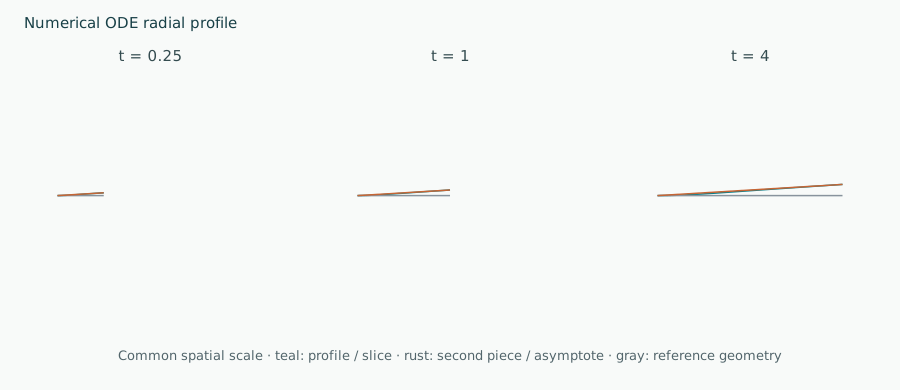
It is an entire graph over $\mathbb R^{n+1}$, hence embedded, complete and proper, with one end. The radial function satisfies $f=O(r^ k)$, $f'=O(r^{k-1})$ at zero, $f,f'\ge 0$, and $f(r)/r\to \varphi _\infty $ at infinity. The limiting cone has slope $\varphi _\infty $; it is not automatically the minimal Lawson–Osserman cone. Uniqueness additionally requires $0\le f\le \varepsilon r$ and $0\le f'\le (2k-1)f/r$ on $(0,R]$. The Hopf map $S^3\to S^2$ gives the first case: a four-dimensional graph in $\mathbb R^7$. The source uses $\mathbf H=F^\perp $; dilation by $\sqrt2$ converts the profile to $\mathbf H=F^\perp /2$, whose flow is $\sqrt t\, \Sigma $, $t>0$. The figure shows radial data, not a seven-dimensional embedding in three-space.
Sources: [Lee2023].
Comments
Comments are not enabled yet.