MCF-stack: Special Solutions of Mean Curvature Flow

§ 4.6 One-sheeted expanders of rotational double cones40FCBC562153

Earliest recorded reference: (publication year).

Paper credits and chronology

Paper credits are chronological and include every author of the cited papers. They identify sources, not exclusive discovery credit. Background-only citations do not determine the date of this example. A classical example may predate the references recorded here.

  1. Angenent–Ilmanen–Chopp — 1995 (publication year).
40FCBC562153
3A4775A9BD2C

(Connected double-cone smoothings) For $n\geq 2$ and a neck parameter $a>0$, the initial value problem

\[ u''=(1+(u')^2)\left(\frac{n-1}{u}+\frac{u-zu'}2\right), \qquad u(0)=a,\quad u'(0)=0, \]

defines a positive, smooth, even profile on $\mathbb R$. Rotating it gives

\[ M_ a=\{ (u(z)\omega ,z):z\in \mathbb R,\ \omega \in S^{n-1}\} \subset \mathbb R^{n+1}. \]

This is a smooth complete properly embedded noncompact expander with topology $S^{n-1}\times \mathbb R$, rotational symmetry, reflection symmetry, and two conical ends. The profile is increasing for $z>0$. Its limiting aperture depends on $a$; the formula is an ODE specification, not an elementary expression. The evolution is $\sqrt t\, M_ a$ for $t>0$.

For every $\alpha >\alpha _{\rm crit}(n+1)$ there exists such a connected expander asymptotic to $D_\alpha $ from Example 4.5. It gives a second thin evolution from that cone alongside the disconnected two-sheeted solution. The cited theorem uses a strict inequality and does not establish a universal uniqueness assertion for the one-sheeted profile. Source: [AIC95], Lemma 2(ii), Lemma 3, and Theorem 4, printed pp. 1947–1951, supplied PDF pp. 12–16. These qualitative expander statements are proved in the source; its separate computed higher-genus shrinker and numerical threshold estimates are not needed here. The interactive figure shows the numerical solution in $\mathbb R^3$ with $a=0.8$ on a finite axial interval.
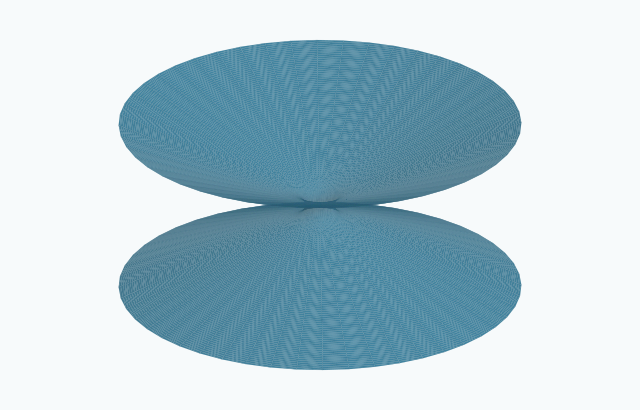
One-sheeted expanders of rotational double cones. Connected rotational expander with neck radius 0.8, shown in the axial window [-5,5]. The drawing makes no claim about a numerically estimated critical cone angle.
Numerical ODE surface. Connected rotational expander with neck radius 0.8, shown in the axial window [-5,5]. The drawing makes no claim about a numerically estimated critical cone angle. Open drawing · Numerical references and credits

Ambient space, topology, embeddedness and entropy
Annulus S¹ × ℝ · Euclidean space ℝ³ · Embedded
Ambient space
Euclidean space ℝ³
Topology
Annulus S¹ × ℝ
Embeddedness
Embedded: The rotational neck is a properly embedded hypersurface.
Compactness
Noncompact
Surface genus
0
Topological ends
2
Entropy
Not recorded: Not recorded in this entry.
Gaussian area
Not recorded: Not recorded in this entry.
Higher-dimensional necks · Euclidean space ℝ⁴; Euclidean dimension ≥ 5 · Embedded
Ambient space
Euclidean space ℝ⁴; Euclidean dimension ≥ 5
Topology
Sⁿ⁻¹ × ℝ, n ≥ 3
Embeddedness
Embedded: The rotational neck is a properly embedded hypersurface.
Compactness
Noncompact
Surface genus
Not a surface
Topological ends
2
Entropy
Not recorded: Not recorded in this entry.
Gaussian area
Not recorded: Not recorded in this entry.

Compare examples by these properties →

References on this page

  1. [AIC95] Sigurd Angenent, Tom Ilmanen, and David L. Chopp. A computed example of nonuniqueness of mean curvature flow in R3. Communications in Partial Differential Equations, 20(11–12):1937–1958, 1995. Supplied PDF has a publisher cover; article p. 1937 is PDF p. 2. Section 2 proves qualitative expander results; the genus-three shrinker is numerical Assertion 1 and the Main Result in Section 4 is conditional. URL: https://doi.org/10.1080/03605309508821158, doi:10.1080/03605309508821158.All uses in this project ↩ 1
Cite this page

Comments

Comments are not enabled yet.