E25A2DDDEA95
(Expanding Lagrangian necks) Fix $n\geq 2$, $a_ j>0$, and $\psi _ j\in \mathbb R$. Set
With $\alpha =1/2$, the exact integral parametrization
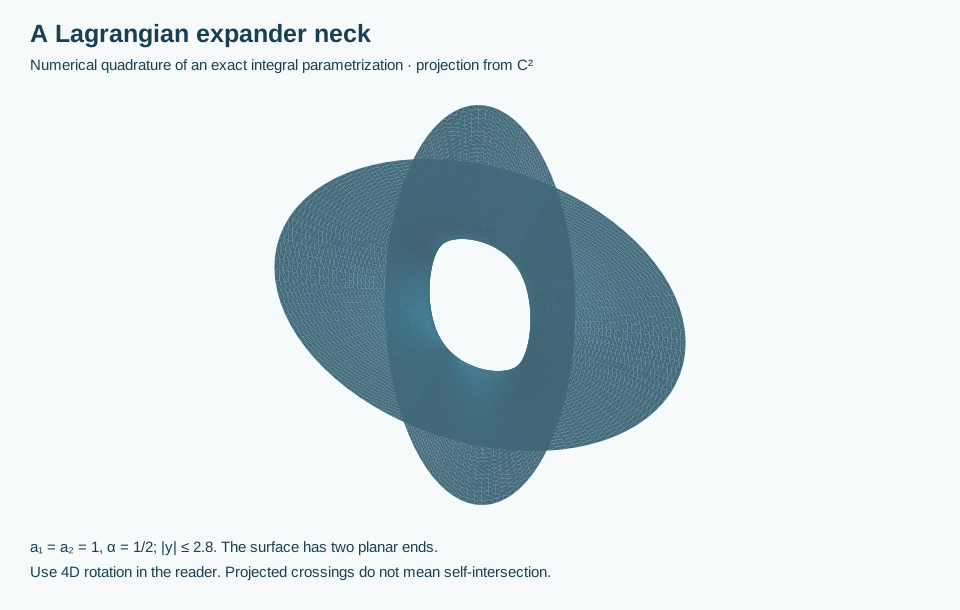
satisfies $\vec H=X^\perp /2$ and gives the flow $\sqrt t\, X$, $t>0$. By [JoyceLeeTsui2010], Theorems C–D, its image is a proper embedded Lagrangian neck. It is complete, has dimension and codimension $n$, and has two ends. For $n=2$ its topology is an annulus; generally it is $\mathbb S^{n-1}\times \mathbb R$.
Write $\bar\phi _ j=\phi _ j(+\infty )-\psi _ j$. The limiting planes have coordinate phases $\psi _ j\pm \bar\phi _ j$, with $0<2\sum _ j\bar\phi _ j<\pi $. Every admissible angle tuple determines unique positive $a_ j$ at fixed $\alpha $ within this family. The neck is zero-Maslov and almost calibrated. Equal $a_ j$ and equal $\psi _ j$ give rotational symmetry under $\mathrm{SO}(n)$.
For $n\geq 3$, the stronger uniqueness theorem in [ImagiJoyceOliveira2016], Theorem 1.2, requires an embedded, exact, closed-as-a-subset Lagrangian expander asymptotic to two transverse planes at rate $\rho <2$. These hypotheses must not be dropped. No general stability claim is attached. The figure projects the $n=2$, $a_1=a_2=1$, $\psi _1=\psi _2=0$ member, evaluating its integrals numerically.
Comments
Comments are not enabled yet.