16898F334139
(Regular expanding trees with prescribed rays) A regular planar network consists of smooth branches meeting only at triple junctions, with angles $120$ degrees at every junction. A self-expanding network $\Sigma \subset \mathbb R^2$ satisfies
on each open branch; its time evolution is $\Sigma _ t=\sqrt t\, \Sigma $, $t>0$, with the same angle condition. It is a network flow and is not a smooth immersed curve at its junctions. For finitely many distinct prescribed rays from the origin, connected tree-like expanders provide smoothings in this network sense. Existence for three rays, including uniqueness of the tree, and existence for more rays are recalled in [INS19], Section 7, printed p. 70, supplied PDF p. 32, with attribution there to Schnürer–Schulze and Mazzeo–Sáez respectively.
The branches can be described as geodesics for the conformal metric
with the junction balance condition. Noncompact ends approach their assigned rays with Gaussian decay. Two regular expanders with the same asymptotic rays coincide if they are in the same topological class: the comparison deformation must retain distinct junctions and the prescribed asymptotic ends, as in the source definition. This does not assert uniqueness across different network topologies. See [INS19], Lemmas 4.1 and 4.3 and Theorem 4.4, printed pp. 49–51, supplied PDF pp. 11–13.
The source uses $\vec k=\psi ^\perp $ and $\sqrt{2t}\, \psi $; our profile is $\Sigma =\sqrt2\, \psi $. Nontrivial networks arise from a geodesic boundary-value construction. The exact balanced special case
is the stationary $Y$ network. It illustrates the junction condition.
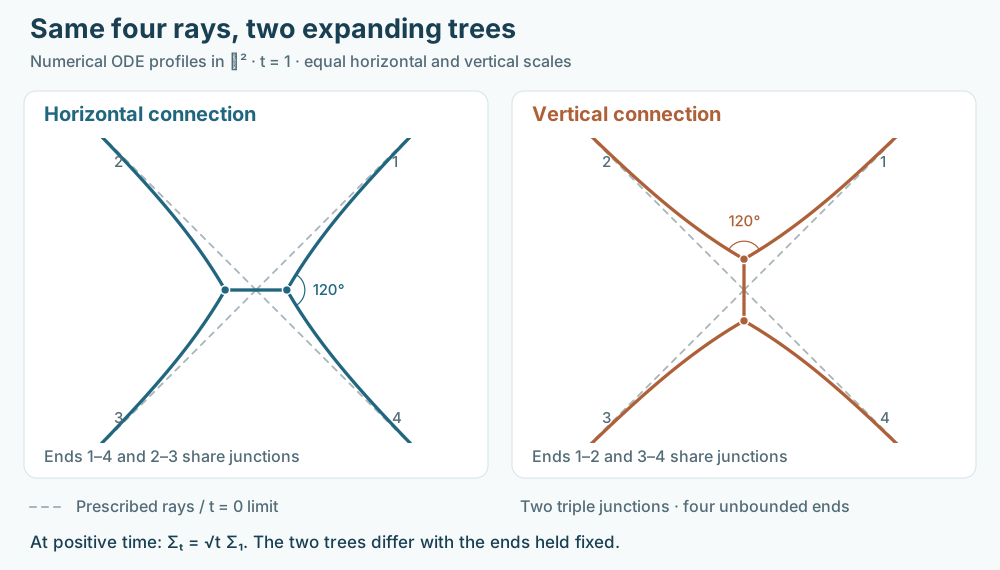
The accompanying picture instead computes a nonstationary four-ended example, using the geodesic construction of [MS07], Sections 2–3. In Euclidean arclength $s$, write the tangent as $(\cos \theta ,\sin \theta )$. Then
Shoot the upper-right branch from $(x,y,\theta )=(a,0,\pi /3)$ toward the ray of angle $\pi /4$. Numerically, $a\approx 0.385405$ in our normalization. Reflections in the coordinate axes and the straight segment $[-a,a]\times \{ 0\} $ give the displayed tree, with triple junctions at $(\pm a,0)$ and asymptotic rays at angles $\pi /4+j\pi /2$, $j=0,1,2,3$. A quarter-turn gives the second tree. The two pictures are congruent by rotation but have different connections when the four asymptotic ends are held fixed. Both have four ends and no cycles. These are numerical ODE approximations, not closed formulas or a classification of all network expanders. The time control shows $\sqrt t\, \Sigma $, $t>0$; the $t=0$ view shows the nonregular initial cone only.
Comments
Comments are not enabled yet.