DA3FCE2F354F
Mramor–Shengwen Wang construct complete properly embedded self-expanders in $\mathbb R^3$ with knotted topology. Their Theorem 3.1 starts with an embedded orientable surface bounding a handlebody and, with sufficiently many ends, produces an expander whose bounded-region topology realizes that handlebody. These surfaces are stable for the weighted functional $\int e^{|X|^2/4}\, d\mu $; this is expander weighted stability, not entropy stability.
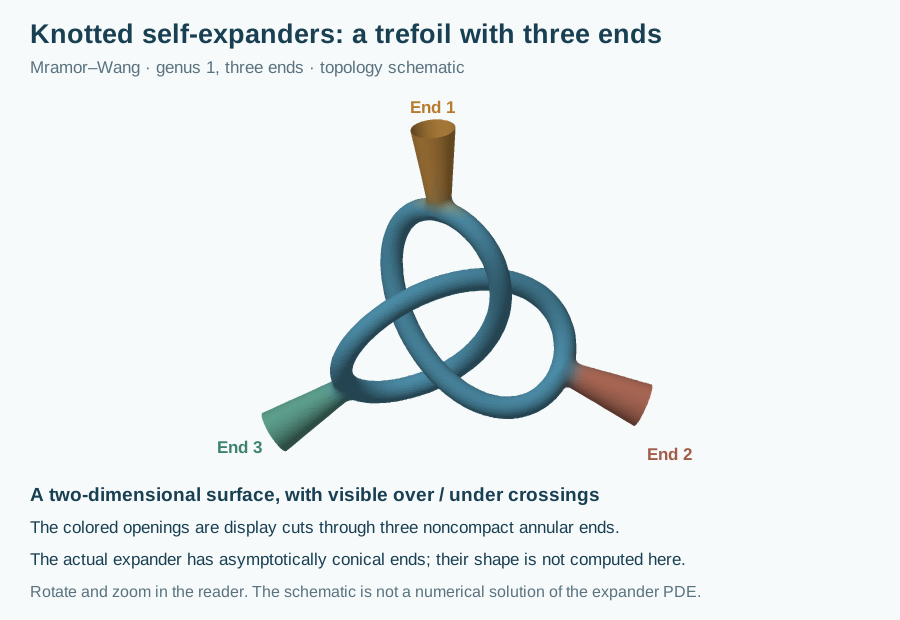
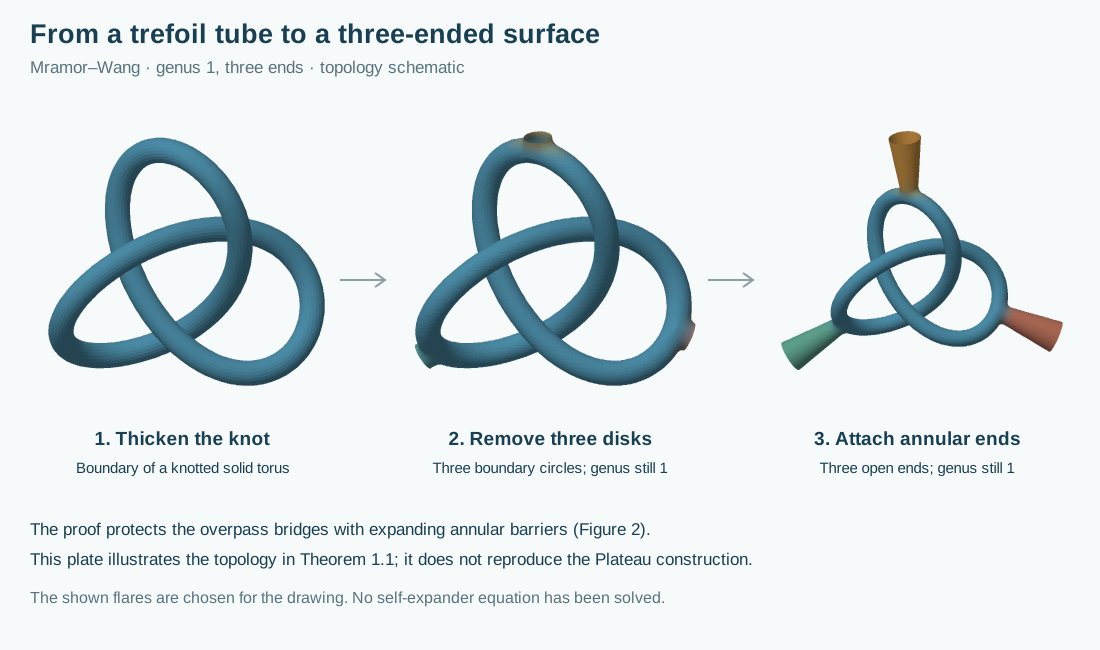
A concrete case has genus one and three ends: inside large balls it is isotopic to the boundary of a tubular neighborhood of a trefoil knot with three disks removed and annular ends attached. The half-cylinders in this description specify topology; the constructed geometric ends are asymptotically conical. More generally, every genus $g\geq 1$ occurs with sufficiently many ends, without a universal end count specified here.
The normalization is $\mathbf H=X^\perp /2$, with flow $M_ t=\sqrt t\, M$ for $t>0$. The examples are noncompact, complete and proper. No explicit formula, uniqueness, or exact Gaussian-area or entropy value is provided; conical area growth gives finiteness. Source: [MWKnotted26], Theorems 1.1 and 3.1 and Corollary 3.2, pp. 2 and 8–10, arXiv v1 (November 2, 2026). This is a preprint construction, not independently verified here. The interactive picture shows a trefoil tube with three annular ends, with auxiliary views of the closed tube and its three punctures. The accompanying plate explains these topological operations; Figure 2 of the paper motivates the bridge description. All displayed shapes are schematics, not computed expanders.
Comments
Comments are not enabled yet.