9910637B58B3
(Expanders from homogeneous potentials) Let $n\geq 2$. Suppose $U_0:\mathbb R^ n\to \mathbb R$ is homogeneous of degree two, is $C^2$ away from the origin, and its Hessian eigenvalues obey
Proposition 6.5 of [TsaiTsuiWang2025] produces the unique solution in the stated continuous-initial-data, smooth-positive-time class of
Then $L_ t=\{ (x,Du(x,t)):x\in \mathbb R^ n\} \subset \mathbb C^ n$, $t>0$, is self-expanding; $L_1$ satisfies $\vec H=X^\perp /2$. These are complete proper embedded graphs of dimension and codimension $n$, homeomorphic to $\mathbb R^ n$, with one end. Hessian bounds persist and higher derivatives obey the estimates in Theorem 5.6. The initial cone is prescribed through the potential; no stronger asymptotic rate is asserted here.
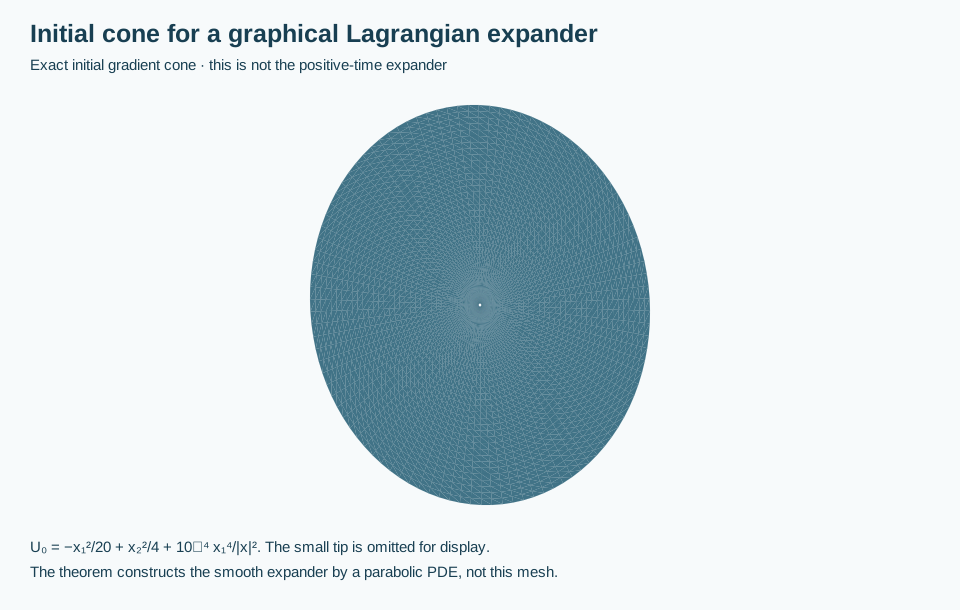
For a concrete nonquadratic seed, take $U_0(0)=0$ and
A direct differentiation bounds the operator norm of $D^2(x_1^4/|x|^2)$ by $38$. Thus one Hessian eigenvalue lies within $0.0038$ of $-0.1$, and the others within $0.0038$ of $0.5$. Both pair inequalities are strictly positive. This verifies the theorem's hypotheses while keeping the potential nonconvex. This formula describes initial data, not the positive-time expander. The illustration shows its exact initial gradient cone and marks the subsequent PDE smoothing as a construction step.
Comments
Comments are not enabled yet.