MCF-stack: Special Solutions of Mean Curvature Flow

§ 4.8 One-sided expanders from mean-convex cones5C7DD27422AD

Earliest recorded reference: (first arXiv submission).

Paper credits and chronology

Paper credits are chronological and include every author of the cited papers. They identify sources, not exclusive discovery credit. Background-only citations do not determine the date of this example. A classical example may predate the references recorded here.

  1. Ding — 2015-03-09 (first arXiv submission).
5C7DD27422AD
A6044506F79A

(Ding's smooth minimizing expanders) Let $C\subset \mathbb R^{n+1}$ be an $n$-dimensional $C^{3,\beta }$-regular cone, $0<\beta <1$, regular away from its vertex, with a $C^{3,\beta }$ embedded link in $S^ n$. Assume that $C$ is mean convex but not area minimizing, that $\partial \Omega =C$, and that its mean curvature vector points into the chosen domain $\Omega $ wherever it is nonzero. Then there is a unique smooth complete embedded $E$-minimizing self-expanding hypersurface $M\subset \Omega $ with tangent cone $C$ at infinity. Its mean curvature vector is everywhere nonzero and points into $\Omega $, and

\[ \{ \sqrt t\, M:t>0\} \]

is a foliation of $\Omega $ moving by mean curvature flow. The normalization is $\vec H=X^\perp /2$.

This is an existence theorem for a family determined by the cone and the chosen side, not an explicit parametrization. The uniqueness just stated includes the chosen-side and minimizing hypotheses. Its topology, symmetry, and number of ends depend on the chosen cone. Source: [Ding20], Theorem 1.1, printed p. 361, supplied PDF p. 3, and Theorem 6.12, printed pp. 402–403, PDF pp. 44–45. The broader minimizing-current existence theorem in that paper can have singularities and is not being substituted for this smooth theorem. The figure is a schematic of the cone, selected domain, and expanding leaves.
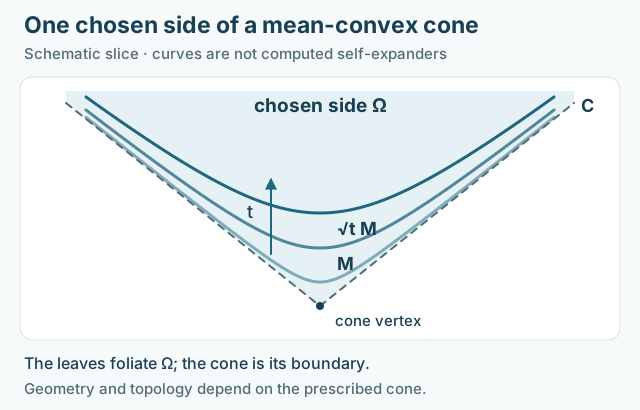
One-sided expanders from mean-convex cones. The cone, chosen side, and homothetic leaves illustrate the theorem. No explicit general-cone expander has been computed.
Foliation schematic. The cone, chosen side, and homothetic leaves illustrate the theorem. No explicit general-cone expander has been computed. Open drawing · Numerical references and credits
Ambient space, topology, embeddedness and entropy
Depends on the chosen cone and side · Euclidean space ℝ³ · Embedded
Ambient space
Euclidean space ℝ³
Topology
Depends on the chosen cone and side
Embeddedness
Embedded: The stated smooth minimizing-expander theorem gives an embedded hypersurface on the chosen side of the cone.
Compactness
Noncompact
Surface genus
Depends on parameters
Topological ends
Depends on parameters
Entropy
Not recorded: Not recorded in this entry.
Gaussian area
Not recorded: Not recorded in this entry.
Higher-dimensional cone smoothings · Euclidean space ℝ⁴; Euclidean dimension ≥ 5 · Embedded
Ambient space
Euclidean space ℝ⁴; Euclidean dimension ≥ 5
Topology
Depends on the chosen cone and side
Embeddedness
Embedded: The stated smooth minimizing-expander theorem gives an embedded hypersurface on the chosen side of the cone.
Compactness
Noncompact
Surface genus
Not a surface
Topological ends
Depends on parameters
Entropy
Not recorded: Not recorded in this entry.
Gaussian area
Not recorded: Not recorded in this entry.

Compare examples by these properties →

References on this page

  1. [Ding20] Qi Ding. Minimal cones and self-expanding solutions for mean curvature flows. Mathematische Annalen, 376:359–405, 2020. Citations use the supplied published 47-page PDF; printed page = PDF page + 358. URL: https://arxiv.org/abs/1503.02612, doi:10.1007/s00208-019-01941-1.All uses in this project ↩ 1
Cite this page

Comments

Comments are not enabled yet.