MCF-stack: Special Solutions of Mean Curvature Flow

§ 4.16 Bi-rotational expanding hypersurfaces6BCE5569C7F9

Earliest recorded reference: (first arXiv submission).

Paper credits and chronology

Paper credits are chronological and include every author of the cited papers. They identify sources, not exclusive discovery credit. Background-only citations do not determine the date of this example. A classical example may predate the references recorded here.

  1. Neto — 2026-10-19 (first arXiv submission).
6BCE5569C7F9
060795635061

Fix integers $p,q\ge 1$. In the 2026 preprint of Silva Neto, an $O(p+1)\times O(q+1)$-invariant expander in $\mathbb R^{p+q+2}$ is generated by

\[ F(s,u,v)=(x(s)u,y(s)v),\quad (u,v)\in S^ p\times S^ q, \]
\[ x'=\cos \sigma ,\quad y'=\sin \sigma ,\quad \sigma '=-\left(\frac px+\frac x2\right)\sin \sigma + \left(\frac qy+\frac y2\right)\cos \sigma . \]

The maximal nonconical profiles give complete proper noncompact hypersurfaces. Axis-starting profiles close smoothly with topology $\mathbb R^{p+1}\times S^ q$ or $\mathbb R^{q+1}\times S^ p$ and are embedded. The two-ended family has topology $\mathbb R\times S^ p\times S^ q$; each point of the open quadrant prescribes its closest point to the origin, up to orientation. Its profile has at most one loop, so embeddedness must be checked for the chosen member. Every end is asymptotically conical, with Euclidean volume growth. The Clifford minimal cone is excluded. The first ambient dimension is four, not three. The time evolution is $\sqrt t\, F$, $t>0$. The numerical meridian and projected torus orbits illustrate a selected $(p,q)=(1,1)$ solution of the stated ODE. The global assertions are attributed to the preprint, not independently verified here.

Sources: [Neto2026].
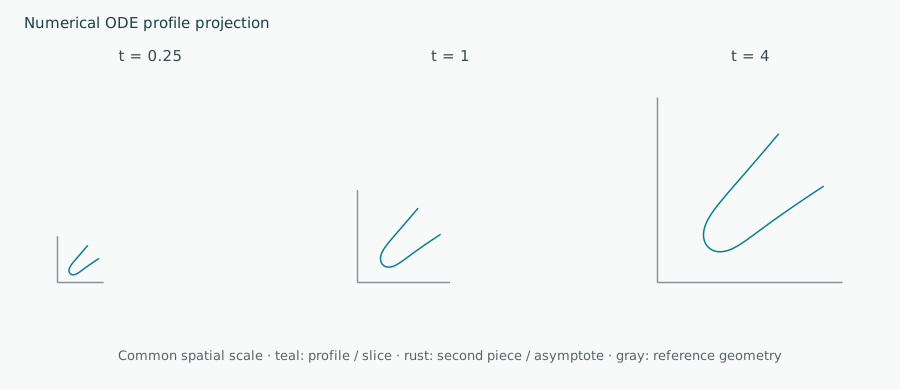
Bi-rotational expanding hypersurfaces. Numerical (p,q)=(1,1) profile and projected circle-pair orbits in ℝ⁴. The conical directions are asymptotic; the profile is not replaced by a cone.
Numerical ODE profile projection. Numerical (p,q)=(1,1) profile and projected circle-pair orbits in ℝ⁴. The conical directions are asymptotic; the profile is not replaced by a cone. Open drawing · Numerical references and credits

Ambient space, topology, embeddedness and entropy

Source construction and dimension restrictions are stated on the reading page. Illustrations have their own accuracy labels.

Two-ended p,q ≥ 1 · Euclidean space ℝ⁴; Euclidean dimension ≥ 5 · Depends on the construction
Ambient space
Euclidean space ℝ⁴; Euclidean dimension ≥ 5
Topology
ℝ × Sᵖ × Sᑫ
Embeddedness
Depends on the construction: The status depends on the chosen input and closing or quotient conditions.
Compactness
Noncompact
Surface genus
Not a smooth surface; surface genus is inapplicable.
Topological ends
Two topological ends.
Entropy
Finite; value not recorded: Finite on each stated smooth slice; no numerical value or uniform time bound is recorded.
Gaussian area
Finite; value not recorded: Finite on each stated smooth slice; no numerical value or uniform time bound is recorded.
Axis-starting p,q ≥ 1 · Euclidean space ℝ⁴; Euclidean dimension ≥ 5 · Embedded
Ambient space
Euclidean space ℝ⁴; Euclidean dimension ≥ 5
Topology
ℝ^(p+1) × Sᑫ or ℝ^(q+1) × Sᵖ
Embeddedness
Embedded: The cited construction gives an embedding for this case.
Compactness
Noncompact
Surface genus
Not a smooth surface; surface genus is inapplicable.
Topological ends
One topological end.
Entropy
Finite; value not recorded: Finite on each stated smooth slice; no numerical value or uniform time bound is recorded.
Gaussian area
Finite; value not recorded: Finite on each stated smooth slice; no numerical value or uniform time bound is recorded.

Compare examples by these properties →

References on this page

  1. [Neto2026] Gregŕio Silva Neto. The global structure of bi-rotational self-expanders. arXiv preprint, 2026. URL: https://arxiv.org/abs/2610.25833, arXiv:2610.25833.All uses in this project ↩ 1
Cite this page

Comments

Comments are not enabled yet.