MCF-stack: Special Solutions of Mean Curvature Flow

§ 4.4 Graphical expanders from general Lipschitz cones152F8E9CDCFA

Earliest recorded reference: (publication year).

Paper credits and chronology

Paper credits are chronological and include every author of the cited papers. They identify sources, not exclusive discovery credit. Background-only citations do not determine the date of this example. A classical example may predate the references recorded here.

  1. Ecker–Huisken — 1989 (publication year).
152F8E9CDCFA
9A84A12D805C

Let $u_0:\mathbb R^ n\to \mathbb R$ be globally Lipschitz and positively homogeneous of degree one. The unique graphical mean curvature flow from this cone is smooth for $t>0$ and respects parabolic scaling. Thus

\[ u(x,t)=\sqrt t\, U(x/\sqrt t),\qquad \left(\delta _{ij}-\frac{U_ iU_ j}{1+|DU|^2}\right)U_{ij} =\frac{U-x\cdot DU}{2}. \]

The graph of $U$ is a complete proper embedded hypersurface diffeomorphic to $\mathbb R^ n$. For cones smooth away from the vertex, the asymptotic statement is understood away from that vertex. This graphical construction does not require rotational symmetry or mean convexity; its uniqueness is in the corresponding graphical evolution class. A concrete nonsymmetric cone for illustration is $u_0(r,\theta )=0.35r\cos (2\theta )$ in $\mathbb R^3$. It is globally Lipschitz and is not the round cone of the existing rotational entry. The displayed positive-time surfaces are finite-domain numerical graphical MCF approximations; the truncation boundary and refinement error are separate from the complete existence theorem.

Sources: [EckerHuisken1989].
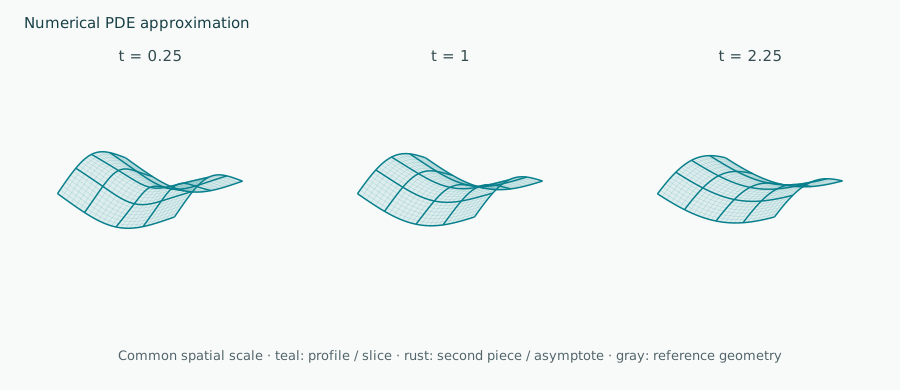
Graphical expanders from general Lipschitz cones. Numerical graphical MCF from the nonround cone 0.35 r cos(2θ). Fixed outer boundary truncates the computation; only the interior is drawn. Three physical times share the same axes.
Numerical PDE approximation. Numerical graphical MCF from the nonround cone 0.35 r cos(2θ). Fixed outer boundary truncates the computation; only the interior is drawn. Three physical times share the same axes. Open drawing · Numerical references and credits

Ambient space, topology, embeddedness and entropy

Source construction and dimension restrictions are stated on the reading page. Illustrations have their own accuracy labels.

n = 2 · Euclidean space ℝ³ · Embedded
Ambient space
Euclidean space ℝ³
Topology
ℝ²
Embeddedness
Embedded: The cited construction gives an embedding for this case.
Compactness
Noncompact
Surface genus
Genus zero.
Topological ends
One topological end.
Entropy
Finite; value not recorded: Finite on each stated smooth slice; no numerical value or uniform time bound is recorded.
Gaussian area
Finite; value not recorded: Finite on each stated smooth slice; no numerical value or uniform time bound is recorded.
n ≥ 3 · Euclidean space ℝ⁴; Euclidean dimension ≥ 5 · Embedded
Ambient space
Euclidean space ℝ⁴; Euclidean dimension ≥ 5
Topology
ℝⁿ
Embeddedness
Embedded: The cited construction gives an embedding for this case.
Compactness
Noncompact
Surface genus
Not a smooth surface; surface genus is inapplicable.
Topological ends
One topological end.
Entropy
Finite; value not recorded: Finite on each stated smooth slice; no numerical value or uniform time bound is recorded.
Gaussian area
Finite; value not recorded: Finite on each stated smooth slice; no numerical value or uniform time bound is recorded.

Compare examples by these properties →

References on this page

  1. [EckerHuisken1989] Klaus Ecker and Gerhard Huisken. Mean Curvature Evolution of Entire Graphs. The Annals of Mathematics, 130:453, 1989. URL: https://doi.org/10.2307/1971452, doi:10.2307/1971452.All uses in this project ↩ 1
Cite this page

Comments

Comments are not enabled yet.